

Types of Digital Marketing: A Complete Guide for Businesses
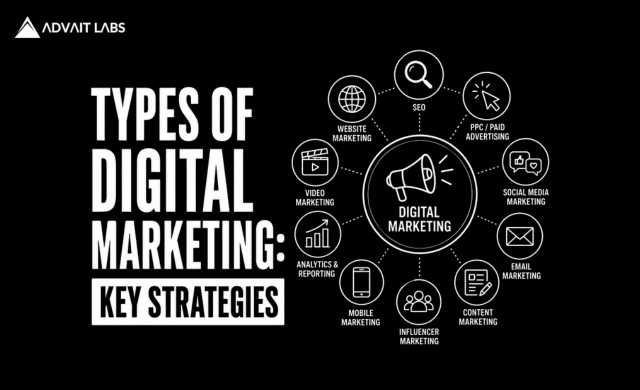
Digital marketing has become an essential part of how businesses attract customers, build brand awareness, generate leads, and increase sales. But digital marketing is not a single activity. It includes several channels and strategies, each designed to achieve different business objectives.
Understanding the types of digital marketing can help businesses decide where to invest their time and budget. While SEO can build long-term organic visibility, paid advertising can generate immediate traffic. Content marketing can establish expertise, while social media can strengthen audience engagement.
At Advait Technology Labs, we provide integrated digital marketing solutions that combine SEO, paid advertising, social media, content, website development, analytics, AEO, and GEO to help businesses build measurable online growth.
What Are the Types of Digital Marketing?
Quick Answer
The major types of digital marketing include:
- Search Engine Optimization (SEO)
- Pay-Per-Click Advertising (PPC)
- Social Media Marketing
- Content Marketing
- Email Marketing
- Affiliate Marketing
- Influencer Marketing
- Mobile Marketing
- Video Marketing
- Local SEO
- Answer Engine Optimization (AEO)
- Generative Engine Optimization (GEO)
Businesses don’t necessarily need all of these channels. The right combination depends on the target audience, industry, business model, and marketing objectives.
1. Search Engine Optimization (SEO)
Search Engine Optimization (SEO) focuses on improving a website’s visibility in organic search results.
SEO can involve:
- Keyword research
- On-page optimization
- Technical SEO
- Content optimization
- Internal linking
- Link building
- Local SEO
- Website architecture
- Competitor analysis
For example, a web design company may optimize its website for searches related to web design services, while a healthcare business may target searches related to specific treatments.
Why SEO Matters
SEO can help businesses:
- Generate organic traffic
- Increase search visibility
- Build topical authority
- Attract high-intent users
- Generate long-term traffic
Unlike paid advertising, organic search traffic doesn’t require paying for every click, although SEO requires ongoing investment in content, technical improvements, and optimization.
2. Pay-Per-Click Advertising (PPC)
PPC advertising allows businesses to pay for advertising opportunities across search engines and other platforms.
Google Ads is one of the most widely used PPC platforms.
PPC campaigns can target users based on factors such as:
- Search queries
- Audiences
- Location
- Devices
- Interests
- Remarketing lists
Benefits of PPC
PPC can provide:
- Faster visibility
- Targeted traffic
- Measurable campaigns
- Flexible budgets
- Conversion-focused advertising
Businesses can also use techniques such as negative keywords, ad scheduling, audience targeting, and conversion tracking to improve campaign efficiency.
3. Social Media Marketing
Social media marketing involves promoting a business through social platforms.
Businesses can use social media to:
- Build brand awareness
- Engage customers
- Promote products
- Share educational content
- Generate leads
- Drive website traffic
Platforms can include:
- YouTube
- X
- Other relevant social networks
Social media strategies can include both organic content and paid advertising.
4. Content Marketing
Content marketing focuses on creating useful and relevant information for a specific audience.
Examples include:
- Blog posts
- Guides
- Case studies
- Whitepapers
- Infographics
- Ebooks
- Videos
- FAQs
Good content helps businesses answer customer questions while building credibility and search visibility.
Content marketing also plays an important role in modern SEO, AEO, and GEO strategies.
5. Email Marketing
Email marketing allows businesses to communicate directly with existing and potential customers.
Common email campaigns include:
- Newsletters
- Product announcements
- Promotional campaigns
- Welcome emails
- Lead nurturing
- Abandoned cart emails
- Customer retention campaigns
Email marketing is particularly useful for businesses that already have an audience or customer database.
6. Affiliate Marketing
Affiliate marketing involves working with third parties that promote a company’s products or services in exchange for a commission or agreed compensation.
Affiliates may promote products through:
- Websites
- Blogs
- Social media
- Content platforms
This model allows businesses to expand their reach through external partners.
7. Influencer Marketing
Influencer marketing involves collaborating with individuals who have an established audience in a specific niche.
Businesses may work with:
- Industry experts
- Content creators
- Niche influencers
- Professional creators
The success of influencer marketing depends on audience relevance, credibility, content quality, and campaign objectives—not simply follower count.
8. Video Marketing
Video has become an important digital marketing format across search, social media, websites, and advertising platforms.
Businesses can use video for:
- Product demonstrations
- Tutorials
- Customer testimonials
- Educational content
- Brand stories
- Short-form videos
- Advertisements
Video marketing can support both awareness and conversion objectives.
9. Local SEO
Local SEO helps businesses improve visibility for searches connected to specific geographic areas.
It is particularly useful for:
- Clinics
- Restaurants
- Hotels
- Retail stores
- Service businesses
- Local professionals
Local SEO can involve:
- Google Business Profile optimization
- Local keyword research
- Location pages
- Reviews
- Local citations
- Local content
- NAP consistency
The objective is to make it easier for customers in relevant locations to discover the business.
10. Mobile Marketing
Mobile marketing focuses on reaching customers through mobile devices.
It can include:
- SMS marketing
- Mobile advertising
- App marketing
- Push notifications
- Mobile-optimized websites
Because many users access websites through smartphones, mobile optimization should also be considered across broader digital marketing campaigns.
11. Answer Engine Optimization (AEO)
Answer Engine Optimization (AEO) focuses on making content easier for search engines and answer engines to understand and use when responding to user questions.
AEO strategies can include:
- Question-based content
- Concise answers
- FAQ sections
- Structured information
- Clear headings
- Search-intent optimization
- Relevant structured data
For example, instead of creating content only around a keyword such as “CRM software,” an AEO-focused strategy may address questions such as:
“What is CRM software and how does it help small businesses?”
12. Generative Engine Optimization (GEO)
Generative Engine Optimization (GEO) focuses on improving a brand’s visibility and representation within AI-powered search and generative experiences.
GEO can involve:
- Building authoritative content
- Strengthening brand entities
- Providing clear factual information
- Developing topical authority
- Creating well-structured content
- Earning relevant mentions and references
GEO should complement rather than replace traditional SEO.
Digital Marketing Channels at Different Stages of the Customer Journey
Different digital marketing strategies can support different stages of the customer journey.
| Customer Stage | Useful Digital Marketing Channels |
| Awareness | Social Media, Video, Content, Display Ads |
| Discovery | SEO, AEO, GEO, Content Marketing |
| Consideration | SEO, Content, PPC, Email |
| Conversion | PPC, Landing Pages, CRO, Remarketing |
| Retention | Email, Social Media, CRM |
| Advocacy | Social Media, Reviews, Referral Marketing |
A strong digital strategy connects these stages rather than treating every channel separately.
How to Choose the Right Digital Marketing Strategy
Start with your business objective.
If You Want More Organic Traffic
Focus on:
SEO + Content Marketing + Technical SEO
If You Need Faster Lead Generation
Consider:
PPC + Landing Pages + Conversion Tracking
If You Want Brand Awareness
Consider:
Social Media + Video Marketing + Content
If You Want More Local Customers
Focus on:
Local SEO + Google Business Profile + Paid Search
If You Want Better AI Search Visibility
Consider:
SEO + AEO + GEO + Authoritative Content
Why Advait Technology Labs for Digital Marketing?
At Advait Technology Labs, we provide integrated digital marketing services designed around business goals.
Our services include:
- SEO
- Google Ads
- Social media marketing
- Content marketing
- Website design and development
- Local SEO
- AEO
- GEO
- Conversion rate optimization
- Analytics and reporting
- CRM and marketing technology solutions
We combine marketing strategy, technology, and data analysis to help businesses understand what’s working and where there are opportunities for improvement.
Our website design and development services focus on fast, SEO-friendly, mobile-optimized websites designed to support user engagement and conversions.
Final Thoughts
Understanding the different types of digital marketing helps businesses build a strategy based on their audience and objectives rather than simply following trends.
SEO can build long-term organic visibility. PPC can provide targeted paid traffic. Social media can strengthen brand engagement. Content marketing can build authority, while email marketing can support customer retention. AEO and GEO are also becoming increasingly relevant as search behavior evolves.
The goal isn’t to use every digital marketing channel. It’s to identify the channels that can create the greatest business impact and connect them into a measurable strategy.
Advait Technology Labs helps businesses bring these capabilities together through integrated digital marketing, website development, analytics, SEO, AEO, and GEO services.
Visit Advait Technology Labs Today!
Frequently Asked Questions
1. What are the main types of digital marketing?
The main types include SEO, PPC advertising, social media marketing, content marketing, email marketing, affiliate marketing, influencer marketing, video marketing, local SEO, mobile marketing, AEO, and GEO.
2. Which type of digital marketing is most effective?
There is no universally best channel. The most effective approach depends on the business, target audience, industry, budget, competition, and marketing objectives.
3. What is the difference between SEO and PPC?
SEO focuses on improving organic search visibility, while PPC uses paid advertising to reach users. SEO generally supports long-term visibility, whereas PPC can provide faster paid exposure.
4. Are AEO and GEO part of digital marketing?
Yes. AEO and GEO are emerging areas of digital marketing focused on improving how businesses and their content appear in answer engines and AI-powered search experiences.
5. What digital marketing services does Advait Technology Labs provide?
Advait Technology Labs provides SEO, Google Ads, social media marketing, content marketing, website design and development, local SEO, AEO, GEO, analytics, and conversion optimization services.
