

How to Get More Google Reviews (and Handle Bad Ones)
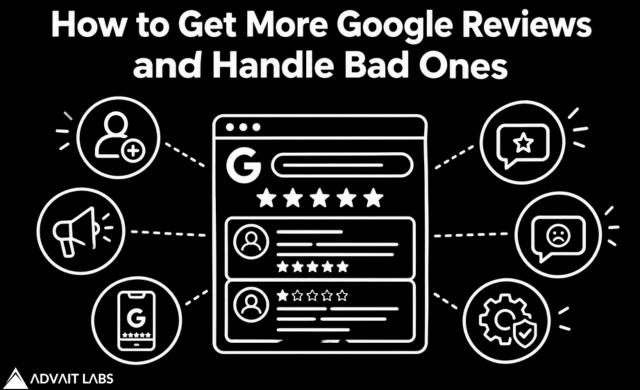
Google reviews can influence how potential customers perceive a business before they ever visit its website, call, or make an enquiry. A strong review profile can provide useful social proof, while thoughtful responses show that a business listens to its customers.
But getting more Google reviews is not simply about asking as many people as possible. Businesses need a consistent and ethical review strategy that makes it easy for genuine customers to share their experiences.
At Advait Labs, we see online reputation management as part of a broader digital strategy. Reviews, local search visibility, website experience, SEO and customer communication all contribute to how people discover and evaluate a business online.
This guide explains how to get more Google reviews naturally, respond to negative feedback professionally and build a stronger online reputation.
Why Are Google Reviews Important for Businesses?
When someone searches for a local business, Google Business Profiles often appear prominently in Search and Maps. Reviews can help potential customers understand what previous customers experienced.
A healthy Google review profile can contribute to:
- Greater customer confidence
- Stronger online reputation
- More informative Google Business Profile listings
- Better engagement with local searchers
- More calls, website visits and enquiries
Reviews are particularly valuable for local businesses because prospective customers frequently compare several options before deciding whom to contact.
However, review count alone should not be the goal. Quality, recency, authenticity and how your business responds to feedback all matter.
How to Get More Google Reviews
1. Ask Customers at the Right Time
Timing can make a significant difference.
Instead of asking for a review randomly, consider requesting feedback after a genuine customer interaction has been completed.
Depending on the business, this could be:
- After a service has been completed
- Following successful delivery
- After resolving a support request
- After a customer confirms they are satisfied
- During an appropriate post-service follow-up
Keep the request simple. Customers should never feel pressured to leave a positive review.
The aim is to encourage an honest review, not to control what the customer says.
2. Make Leaving a Review Easy
Even satisfied customers may not leave a review if the process takes too long.
Provide customers with a direct Google review link wherever appropriate. Instead of asking them to search for your business manually, take them directly to the review process.
The link can be included in:
- Follow-up emails
- SMS messages
- WhatsApp communication
- Receipts or invoices
- Thank-you pages
- QR codes at physical locations
Reducing unnecessary steps can make customers more likely to complete the process.
3. Send a Polite Follow-Up
Customers are busy. Someone may intend to leave a review and simply forget.
A short follow-up reminder can help.
Avoid sending repeated requests. One appropriately timed reminder is usually more professional than repeatedly contacting someone for feedback.
Your message should focus on the customer’s experience rather than asking specifically for a five-star rating.
For example, you can ask customers to share their experience so that other people can better understand your service.
4. Add a Google Review Link to Your Website
Your website can also support your Google review strategy.
Consider placing a review CTA on relevant pages such as:
- Contact page
- Thank-you page
- Customer support page
- Post-purchase page
- Testimonials or reviews page
Existing customers who return to your website then have another convenient way to provide feedback.
Avoid intrusive pop-ups that ask every visitor for a review, especially when the visitor may never have used your service.
5. Use QR Codes for Offline Customers
Businesses with physical locations can connect offline experiences with their online reputation.
A QR code linked to your Google review page can be placed on appropriate materials such as receipts, checkout counters, appointment cards or post-service documents.
Customers can scan the code with their phone and access the review page directly.
Make sure the QR code is clearly labelled and tested before publishing it.
6. Train Your Team to Ask Naturally
Employees who interact directly with customers can play an important role in generating authentic reviews.
However, the request should sound natural rather than scripted or aggressive.
Train staff to:
- Ask at an appropriate point in the customer journey
- Explain where the customer can leave feedback
- Avoid requesting only positive reviews
- Never tell customers what rating to give
- Avoid offering inappropriate incentives in exchange for favourable reviews
A sustainable Google review strategy depends on authentic customer experiences.
7. Respond to Your Existing Google Reviews
Generating reviews is only half of online reputation management. Businesses should also engage with the feedback they already receive.
Responding demonstrates that customer opinions are being acknowledged.
For positive reviews, keep responses genuine and relevant. You can thank the customer and acknowledge something specific about their experience where appropriate.
Avoid copying exactly the same response under every review.
How Should You Respond to a Bad Google Review?
Negative reviews can be uncomfortable, but an emotional response can create a larger reputation problem than the original complaint.
A professional response should acknowledge the feedback without immediately becoming defensive.
1. Read the Review Carefully
Before replying, understand what the reviewer is actually complaining about.
Consider:
- What happened?
- Is the complaint specific?
- Can you verify the interaction internally?
- Is there a genuine service issue?
- Does the review appear unrelated to your business?
Investigate before responding whenever possible.
2. Keep Your Response Professional
Remember that your response is public.
You are not only replying to the reviewer. Future customers may also read the conversation.
Avoid:
- Arguments
- Sarcasm
- Accusations
- Sharing private customer information
- Long defensive explanations
Keep the response calm, concise and focused on resolving the issue where possible.
3. Acknowledge the Customer’s Experience
Acknowledging feedback does not necessarily mean agreeing with every allegation.
You can recognise that the customer had an unsatisfactory experience and indicate that you would like to understand what happened.
If the business clearly made a mistake, an appropriate apology and corrective action may be more effective than trying to defend it.
4. Move Complex Discussions Offline
A Google review thread is rarely the best place to resolve a detailed dispute.
Where appropriate, invite the reviewer to contact the business directly so the issue can be investigated.
This protects privacy and prevents a lengthy public argument.
5. Report Reviews That Violate Google’s Policies
Not every negative review should be removed simply because it is unfavourable.
However, if a review violates Google’s policies, businesses can use the available reporting process.
A low rating or criticism alone is not necessarily grounds for removal. Businesses should distinguish between genuine negative feedback and content that may violate platform policies.
Should You Respond to Every Google Review?
Responding consistently can be beneficial, but the quality of the response matters more than producing generic replies at scale.
Prioritise:
- Detailed customer feedback
- Negative reviews that require attention
- Reviews containing questions
- Reviews mentioning specific experiences
- Feedback that gives you an opportunity to clarify or resolve an issue
For positive reviews, a brief personalised thank-you can be sufficient.
What Should You Avoid When Trying to Get More Reviews?
Shortcuts can damage trust and potentially create platform problems.
Avoid practices such as:
- Buying Google reviews
- Creating fake customer accounts
- Asking employees to impersonate customers
- Pressuring customers to leave five-star ratings
- Posting reviews on behalf of customers
- Attempting to suppress every legitimate negative review
- Using the exact same review request repeatedly without context
A smaller number of authentic reviews is more valuable for reputation than a profile filled with questionable feedback.
How Google Reviews Support Local SEO
Google reviews and local SEO are closely connected, although reviews are only one part of local search visibility.
A complete local SEO strategy may also involve:
- An accurate Google Business Profile
- Correct business categories
- Consistent business information
- Relevant local website content
- Quality backlinks and citations
- Strong website experience
- Local keyword optimisation
- Genuine customer reviews
Businesses should therefore avoid treating review generation as an isolated tactic.
The stronger approach is to connect Google Business Profile optimisation, reputation management and local SEO within the wider digital strategy.
How to Build a Sustainable Online Reputation
A strong reputation cannot be manufactured through marketing alone.
It begins with the customer experience.
A sustainable reputation management process typically follows a simple cycle:
Deliver a good experience → request honest feedback → monitor reviews → respond appropriately → learn from recurring issues → improve the experience.
If several customers repeatedly mention the same problem, the solution is not simply writing better review responses. The underlying customer experience may need improvement.
That distinction is important.
Reputation management should help a business understand its reputation, not disguise it.
When Should You Consider Professional Reputation Management?
Managing reviews manually may be straightforward when a business receives only a few each month. It becomes more difficult as the number of locations, customers and review platforms grows.
Professional support may be useful when:
- Your business has multiple locations
- Reviews regularly go unanswered
- Negative feedback is increasing
- Local search visibility is weak
- Teams do not have a consistent response process
- You need better review monitoring and reporting
- Your Google Business Profile is not properly optimised
- Reputation management is disconnected from SEO and marketing
The objective should not simply be to collect more five-star reviews. It should be to create a reliable system for collecting, monitoring and learning from genuine customer feedback.
Build a Stronger Digital Reputation with Advait Labs
Getting more Google reviews requires more than occasionally asking customers for feedback.
Businesses need a structured approach that connects the customer experience with Google Business Profile optimisation, local SEO and online reputation management.
At Advait Labs, we help businesses identify gaps in their digital presence and develop strategies designed around visibility, customer experience and measurable business objectives.
If your business is struggling with Google reviews, local visibility or inconsistent online reputation management, a digital presence audit can help identify where improvements are needed.
Frequently Asked Questions
1. How can I get more Google reviews for my business?
Ask genuine customers for honest feedback at an appropriate point after their interaction and provide a direct Google review link. Email, SMS, WhatsApp, QR codes and post-service pages can make the process easier.
2. Can businesses ask customers for Google reviews?
Businesses can encourage customers to share genuine feedback, but review requests should follow Google’s applicable policies. Avoid manipulating ratings, posting fake reviews or pressuring customers to provide only positive feedback.
3. How should a business respond to a negative Google review?
Respond calmly, acknowledge the feedback, investigate the issue and offer an appropriate way to continue the discussion privately when necessary. Avoid arguments or disclosing personal information publicly.
4. Do Google reviews help with local SEO?
Reviews can contribute to a business’s overall local search presence, but they are not the only factor. Google Business Profile optimisation, relevance, website quality, local signals and other factors also contribute to local visibility.
5. Should I hire someone to manage Google reviews?
Professional reputation management may be useful for businesses with multiple locations, high review volumes, recurring negative feedback or limited internal resources. The provider should focus on genuine feedback and responsible reputation management rather than fake reviews.
