

How to Choose the Right CRM for a Growing Business in India
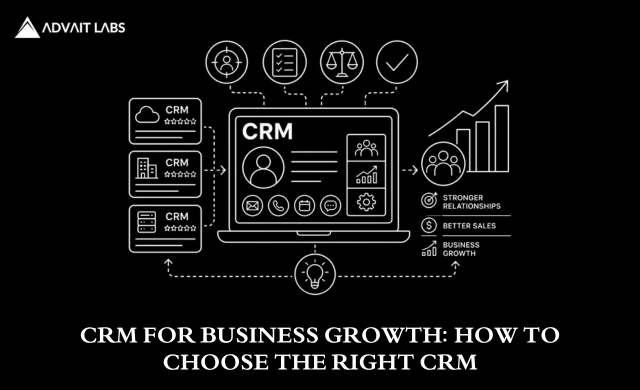
CRM for business growth has become essential for companies that want to manage leads efficiently, improve customer relationships, and scale operations without losing visibility into sales and customer interactions. As businesses grow, spreadsheets, scattered customer data, and manual follow-ups often become major obstacles to productivity and revenue growth.
A Customer Relationship Management (CRM) system helps businesses centralize customer information, streamline sales processes, automate repetitive tasks, and improve communication across teams. However, with dozens of CRM platforms available in the market, choosing the right solution can feel overwhelming.
The ideal CRM should align with your business goals, support your sales process, and scale as your company grows. A CRM that works well for a startup may not meet the needs of a rapidly expanding business.
At Advait Technology Labs, we help businesses implement CRM solutions that improve efficiency, automate workflows, and support long-term growth. In this guide, we’ll explore how to choose the right CRM for a growing business in India and the factors that matter most during the selection process.
What Is a CRM?
A CRM (Customer Relationship Management) system is software that helps businesses manage customer interactions, track leads, organize sales activities, and improve customer relationships through a centralized platform.
A CRM typically stores:
- Customer information
- Lead data
- Communication history
- Sales opportunities
- Tasks and follow-ups
- Customer support interactions
By keeping all customer-related information in one place, businesses can improve efficiency and make more informed decisions.
Why Is a CRM Important for Growing Businesses?
As a business expands, customer interactions increase significantly.
Without a CRM, teams often struggle with:
- Lost leads
- Missed follow-ups
- Duplicate data
- Inconsistent customer communication
- Poor visibility into sales performance
A CRM helps solve these challenges by creating a structured system for managing customer relationships.
Benefits include:
- Better lead management
- Improved customer retention
- Faster sales processes
- Higher team productivity
- More accurate reporting
For growing businesses, a CRM often becomes the foundation of scalable sales and customer management.
When Does a Business Need a CRM?
Many companies wait too long before implementing a CRM.
Common signs that indicate you need a CRM include:
Leads Are Falling Through the Cracks
If sales inquiries are being missed or forgotten, a CRM can help track every opportunity.
Customer Data Is Scattered
When information is stored across spreadsheets, emails, and multiple tools, managing relationships becomes difficult.
Sales Processes Are Inconsistent
A CRM creates standardized workflows that improve efficiency.
Reporting Takes Too Long
CRM systems provide real-time insights into sales performance and customer activity.
Business Growth Is Accelerating
As customer volume increases, manual processes become harder to manage effectively.
What Features Should You Look for in a CRM?
Not every CRM offers the same functionality.
The right CRM for business growth should include features that support your current needs while allowing room for future expansion.
Lead Management
Lead management is one of the most important CRM capabilities.
A good CRM should help you:
- Capture leads automatically
- Track lead sources
- Assign leads to team members
- Monitor lead status
- Manage follow-ups
This ensures opportunities are not lost during the sales process.
Contact Management
A CRM should provide a complete view of customer interactions.
Look for features such as:
- Contact profiles
- Communication history
- Notes and activities
- Customer segmentation
This helps teams deliver more personalized experiences.
Sales Pipeline Tracking
Pipeline visibility allows businesses to monitor opportunities at every stage of the sales cycle.
A strong CRM should help you:
- Track deals
- Monitor progress
- Identify bottlenecks
- Forecast revenue
This improves sales management and planning.
Workflow Automation
Automation reduces manual work and improves efficiency.
Examples include:
- Automated follow-up emails
- Lead assignment
- Task reminders
- Status updates
Automation helps teams focus on high-value activities rather than repetitive administrative tasks.
Reporting and Analytics
Data-driven decision-making is essential for growth.
A CRM should provide insights into:
- Lead performance
- Conversion rates
- Sales trends
- Team productivity
- Revenue forecasts
Accurate reporting helps businesses identify opportunities for improvement.
Cloud CRM vs On-Premise CRM
One of the first decisions businesses face is choosing between cloud-based and on-premise CRM solutions.
Cloud CRM
Cloud CRM systems are hosted online and accessed through the internet.
Benefits include:
- Lower upfront costs
- Faster implementation
- Easy scalability
- Remote accessibility
- Automatic updates
Most growing businesses today prefer cloud-based CRM platforms.
On-Premise CRM
On-premise systems are installed on company-owned infrastructure.
Benefits may include:
- Greater control
- Custom security requirements
- Internal hosting preferences
However, these systems often require higher maintenance and infrastructure costs.
How to Evaluate CRM Vendors
Choosing the right CRM involves more than comparing feature lists.
Consider the following factors when evaluating vendors.
Ease of Use
A CRM should be intuitive and easy for teams to adopt.
Complicated systems often face low adoption rates.
Request demonstrations and involve end-users during evaluation.
Scalability
Your CRM should support future growth.
Consider:
- Additional users
- New departments
- Workflow expansion
- Integrations
Selecting a scalable solution reduces the need for future system replacements.
Integration Capabilities
A CRM should connect with the tools your business already uses.
Examples include:
- ERP systems
- Email platforms
- Marketing automation tools
- Accounting software
- Customer support systems
Strong integrations improve efficiency and reduce data silos.
Customer Support
Reliable support becomes critical during implementation and ongoing use.
Evaluate:
- Training resources
- Technical support
- Implementation assistance
- Customer success services
Strong vendor support often contributes to long-term CRM success.
CRM for Business Growth in India
Indian businesses face unique challenges and opportunities when selecting CRM solutions.
Factors to consider include:
Multi-Location Operations
Businesses operating across multiple cities need centralized customer management.
WhatsApp and Mobile Integration
Many customer interactions in India occur through mobile devices and messaging platforms.
Regional Sales Teams
CRM systems should support distributed teams and field sales operations.
Scalability
India’s growing digital economy often requires businesses to scale rapidly.
Selecting a CRM that supports these requirements can improve long-term success.
How CRM Supports AI, Automation, and Digital Transformation
Modern CRM platforms increasingly include:
- Artificial intelligence
- Predictive analytics
- Workflow automation
- Customer intelligence
These capabilities help businesses:
- Predict customer behavior
- Improve lead scoring
- Personalize communication
- Increase sales efficiency
As AI becomes more important, businesses should consider CRM platforms that support future automation initiatives.
Common CRM Selection Mistakes
Avoid these common mistakes when choosing a CRM.
Choosing Based Only on Price
The cheapest option may lack critical functionality.
Ignoring User Adoption
A CRM is only valuable if employees actively use it.
Overlooking Integration Needs
Disconnected systems create inefficiencies and data silos.
Focusing Only on Current Requirements
Choose a solution that supports future growth.
Skipping Implementation Planning
Successful CRM adoption requires proper setup, training, and process alignment.
How Advait Technology Labs Helps Businesses Implement CRM Solutions
At Advait Technology Labs, we help businesses select, implement, and optimize CRM systems that support long-term growth.
Our services include:
- CRM consulting
- CRM implementation
- Workflow automation
- CRM integration
- ERP and CRM connectivity
- Business process optimization
- User training
- Digital transformation strategy
We focus on creating CRM ecosystems that improve customer management, sales performance, and operational efficiency.
Final Thoughts
Choosing the right CRM for business growth is one of the most important technology decisions a growing company can make. The right CRM helps manage customer relationships, improve sales efficiency, automate workflows, and provide valuable business insights.
Rather than selecting a platform based solely on features or pricing, businesses should evaluate scalability, usability, integrations, and long-term business objectives.
As customer expectations continue to evolve and competition increases, a well-implemented CRM can become a powerful driver of growth, productivity, and customer satisfaction.
Frequently Asked Questions
What is a CRM for business?
A CRM for business is software that helps companies manage customer relationships, track leads, organize sales activities, and improve customer interactions.
Why do growing businesses need a CRM?
Growing businesses need a CRM to manage increasing customer interactions, improve sales processes, automate tasks, and maintain organized customer data.
What features should a CRM have?
Important CRM features include lead management, contact management, sales pipeline tracking, workflow automation, reporting, and integrations.
Is cloud CRM better for small and growing businesses?
For most businesses, cloud CRM offers easier implementation, lower costs, scalability, and remote access compared to on-premise systems.
How do I choose the right CRM?
Evaluate ease of use, scalability, integration capabilities, reporting features, automation options, customer support, and alignment with your business goals.
