

How Content Optimization Improves Time on Page and Rankings
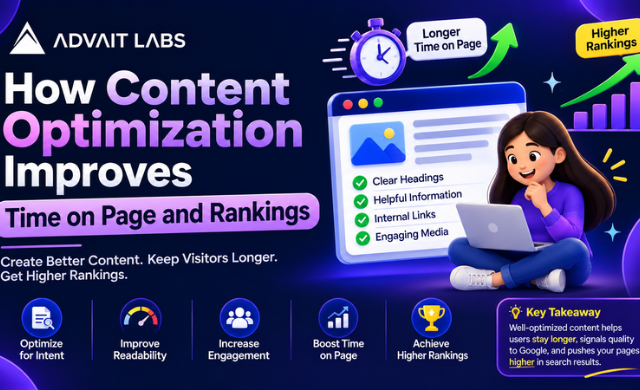
Good content should do more than attract someone to a webpage. It should help them find the information they need, understand it quickly, and know what to do next. That is where content optimization becomes important.
When a page is difficult to scan, poorly structured, too generic, or mismatched with search intent, visitors may leave before finding their answer. Better content structure, relevance, readability, and useful information can create a more satisfying experience and give search engines clearer context about the page.
For businesses investing in SEO, the goal is not simply to make a page longer. It is to make every section more useful.
Want to improve how your website content performs? Explore Advait Labs’ SEO and content optimisation services in Hyderabad.
What Is Content Optimization?
Content optimization is the process of improving existing or new website content so that it is useful to readers, easy to understand, relevant to the search query, and technically accessible to search engines.
It can involve several areas, including:
- Understanding the search intent behind a keyword
- Improving headings and content structure
- Making paragraphs easier to scan
- Adding useful examples and explanations
- Removing unnecessary or repetitive information
- Strengthening internal links
- Improving title tags and meta descriptions
- Optimising images and alt text
- Reviewing duplicate or thin content
- Checking technical SEO issues
- Making sure important pages can be crawled and indexed
The key is balance. Content should be written for people first while making the page structure clear enough for search engines to understand.
How Content Optimization Can Improve Time on Page
Time on page can provide useful insight into how visitors interact with a webpage, but it should not be treated as a standalone measure of SEO success.
A visitor who spends several minutes reading a detailed guide may be highly engaged. However, someone who finds an answer within 30 seconds may also have had a successful visit.
This is why improving time on page should not mean deliberately making content longer. Instead, focus on making the page genuinely useful.
Match Content With Search Intent
Search intent describes what a person is actually trying to accomplish with a search.
For example, someone searching for “how to optimise website content” may want a practical process rather than a general definition.
Before writing, ask:
- What problem is the user trying to solve?
- What information would they expect to find?
- What questions are likely to follow?
- Does the page answer the main question quickly?
- What useful detail can be provided after the initial answer?
When content matches intent, users have a clearer reason to continue reading.
Improve Content Readability
Large blocks of text can make even useful information difficult to consume.
Make content easier to scan by using:
- Short paragraphs
- Descriptive headings
- Bullet points
- Numbered steps
- Relevant examples
- Bold emphasis for important terms
- Clear transitions between sections
Good readability helps visitors locate the information that matters to them without forcing them to read every sentence.
Give Readers a Reason to Continue
Each section should naturally lead into the next.
For example, a page about content optimisation could move from:
What content optimisation means → why it matters → how to optimise content → technical checks → measurement → common mistakes.
This creates a logical reading journey rather than a collection of disconnected paragraphs.
Content Optimization and Search Rankings
There is an important distinction between engagement metrics and search ranking signals.
Time on page should not be treated as a direct ranking formula. Instead, content optimisation supports a broader SEO strategy by improving relevance, usefulness, structure, accessibility, and the overall quality of the page.
A well-optimised page should help search engines understand:
- What the page is about
- Which topic it covers
- What questions it answers
- How the information is organised
- Which related pages provide additional context
At the same time, visitors should be able to understand the page without unnecessary effort.
How to Optimise Content for SEO
Start With Search Intent
Identify the intent before selecting headings or writing paragraphs.
Common search intents include:
- Informational: the user wants to learn something
- Commercial: the user is comparing options
- Transactional: the user is ready to take action
- Navigational: the user is looking for a specific website or page
The same keyword can sometimes have multiple interpretations, so the content should address the most relevant user need.
Build a Clear Heading Structure
Use one clear H1 for the main topic.
Then use H2 headings for major sections and H3 headings for supporting topics.
For example:
H1: Content Optimization for SEO
H2: What Is Content Optimization?
H2: How to Optimise Website Content
H3: Improve Readability
H3: Match Search Intent
H2: Technical SEO Checks
This structure improves navigation and makes the relationship between topics easier to understand.
Strengthen Internal Links
Internal links connect related pages on the same website.
Instead of adding links randomly, use them when another page provides useful additional information.
For example, an article about content optimisation could link to pages about:
- On-page SEO
- Keyword research
- Technical SEO
- Image SEO
- Local SEO
- SEO audits
Relevant internal linking can help users discover more information while creating stronger connections between related topics.
Technical SEO Checks That Support Content
Even well-written content can face visibility problems if search engines cannot properly access or understand the page.
Check Crawlability
Search engines need to be able to access important pages.
Review technical issues that may prevent crawling, including inappropriate robots directives, broken internal links, or incorrectly configured website sections.
Review Indexing Status
A page generally needs to be indexed before it can appear in organic search results.
Google Search Console can help website owners review whether important URLs are indexed and identify pages that may need further investigation.
Use the URL Inspection Tool
The URL Inspection Tool can be used to review the indexing status and technical information associated with an individual URL.
It is particularly useful when a newly published or updated page does not appear to be indexed as expected.
Check Noindex Tags
A noindex directive tells search engines not to include a page in their index.
Review important pages carefully to ensure that a noindex instruction has not been applied unintentionally.
Maintain an XML Sitemap
An XML sitemap provides search engines with a structured list of URLs that a website wants them to discover.
It should be kept current and should not be treated as a replacement for strong internal linking.
Look for Duplicate Content
Duplicate or substantially similar pages can make it harder to maintain a clear content structure.
Review pages with overlapping topics, similar URLs, copied sections, or multiple versions of the same information.
Where appropriate, improve the unique value of each page or consolidate overlapping content.
Run Plagiarism and Originality Checks
Plagiarism checks can help identify copied passages before publication.
However, originality is only one part of content quality. A page can be original and still fail to answer the reader’s question clearly.
The stronger approach is to combine originality with useful information, appropriate depth, accurate structure, and clear search intent.
How to Measure the Impact of Content Optimization
Content optimisation should be evaluated using several signals rather than one number.
Depending on the analytics setup, useful areas to monitor include:
- Organic clicks
- Organic impressions
- Search queries
- Average position
- Click-through rate
- Engagement metrics
- Average engagement time
- Conversions
- Internal link interactions
- Indexed page status
Google Search Console can help you understand how pages appear in search, while your analytics platform can provide additional information about visitor behaviour.
Look at changes over time rather than judging a page based on a single metric.
For example, if a page receives more relevant organic traffic after its content is improved, that may be more meaningful than simply seeing an increase in time spent on the page.
Common Content Optimization Mistakes
Writing for Keywords Instead of People
Repeating a keyword excessively can make content awkward and reduce readability.
Use the primary keyword naturally and rely on related terms, questions, examples, and supporting concepts to provide context.
Making Content Longer Without Making It Better
More words do not automatically create better content.
Remove repetitive explanations and focus on information that helps the reader make a decision, understand a topic, or complete a task.
Ignoring Existing Content
SEO content optimisation does not always require publishing another article.
Existing pages may benefit from:
- Updated information
- Better headings
- Improved examples
- Stronger internal links
- Better keyword targeting
- Improved metadata
- Removal of outdated sections
- Technical SEO fixes
Forgetting the User’s Next Step
A useful page should make the next action clear.
That action could be reading another article, exploring a service, requesting information, comparing options, or contacting the business.
A Practical Content Optimization Checklist
Before publishing or updating a page, ask:
- Does the page clearly match the search intent?
- Is the main topic obvious from the H1 and introduction?
- Are the headings logically structured?
- Can the content be scanned easily?
- Does each section add something useful?
- Are keywords used naturally?
- Are relevant internal links included?
- Are images properly optimised?
- Is the URL clear and relevant?
- Can the page be crawled?
- Is the page eligible for indexing?
- Is there an unintended noindex directive?
- Is the page included appropriately in the XML sitemap?
- Are there duplicate or overlapping pages?
- Has the content been checked for copied text?
- Does the page offer a clear next step?
A consistent review process can make content optimisation more systematic instead of treating SEO as a one-time task.
Conclusion
Effective content optimization is not about adding keywords or increasing word count simply to make a page appear more comprehensive.
It is about making the right information easier to find, understand, navigate, and act on.
Improving search intent alignment, readability, content structure, internal linking, metadata, and technical accessibility can create a stronger foundation for organic search visibility. Time on page can be useful as part of that evaluation, but it should be considered alongside other engagement, search, and conversion metrics.
For businesses in Hyderabad, a practical approach is to review existing content first, identify the pages with the greatest opportunities, and then improve them systematically.
Looking to improve your website’s content and SEO strategy? Connect with Advait Labs in Hyderabad to review your content, on-page SEO, and technical optimisation opportunities.
Common Questions About Content Optimization
What is content optimization in SEO?
Content optimization is the process of improving website content so that it better matches search intent, provides useful information, remains easy to read, and has a clear structure for both visitors and search engines.
How can content optimization improve time on page?
Useful, relevant, well-structured content can give visitors more reason to continue reading. Improving readability, answering related questions, and creating a logical flow can make a page easier to consume.
Does time on page directly affect Google rankings?
Time on page should not be treated as a direct ranking formula. It is better used as one of several behavioural and engagement measurements when evaluating how users interact with content.
How do I optimise content for search intent?
Start by identifying what the user wants to accomplish with the search. Then structure the page around that need, answer the main question clearly, and provide relevant supporting information without unnecessary sections.
How often should website content be updated?
There is no universal update schedule. Content should be reviewed when information becomes outdated, search intent changes, the page underperforms, or there are clear opportunities to improve usefulness and clarity.
Can old content be optimized instead of creating a new page?
Yes. Existing content can often be improved through better structure, updated information, stronger internal links, improved metadata, clearer search intent alignment, and technical SEO checks.
How can Google Search Console help with content optimization?
Google Search Console can help review search queries, impressions, clicks, average position, and indexing information. These insights can help identify pages and topics that deserve further optimisation.
