

How Complex Event Processing Help Reduce Customer Churn
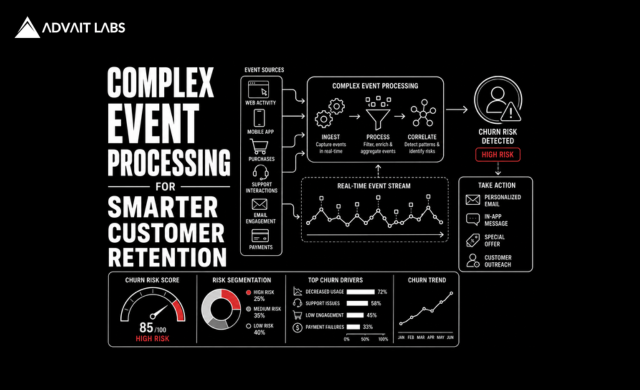
Complex Event Processing is transforming how businesses identify and prevent customer churn. In today’s competitive digital landscape, waiting until a customer cancels a subscription or stops purchasing is no longer enough. Businesses need real-time insights that allow them to recognize warning signs early and take proactive action. Complex Event Processing (CEP) makes this possible by continuously analyzing streams of customer interactions and detecting meaningful patterns as they happen. At Advait Technology Labs, we help organizations implement intelligent CRM, ERP, and data-driven solutions that use Complex Event Processing to improve customer retention, automate decision-making, and deliver personalized customer experiences. This guide explains how CEP works and why it has become a valuable tool for reducing customer churn.
What Is Complex Event Processing?
Complex Event Processing (CEP) is a technology that processes and analyzes multiple streams of real-time events to identify meaningful patterns, trends, or anomalies.
Rather than examining individual events separately, CEP combines data from multiple sources to trigger immediate business actions.
Examples of events include:
- Website visits
- Mobile app activity
- Purchase history
- CRM updates
- Customer support tickets
- Payment transactions
- Email engagement
- IoT device data
By connecting these events, businesses can respond to customer behavior before problems escalate.
What Is Customer Churn?
Customer churn refers to the percentage of customers who stop using a company’s products or services during a specific period.
Common signs of churn include:
- Subscription cancellations
- Reduced purchases
- Lower website engagement
- Inactive customer accounts
- Unanswered marketing emails
- Negative customer feedback
Reducing churn is often more cost-effective than acquiring new customers.
Why Customer Churn Happens
Customers leave businesses for many reasons.
Common causes include:
- Poor customer service
- Slow issue resolution
- Better competitor offers
- Lack of engagement
- Irrelevant communication
- Poor product experience
- Pricing concerns
The earlier these warning signs are detected, the greater the opportunity to retain customers.
How Complex Event Processing Helps Reduce Customer Churn
CEP continuously monitors customer activity across multiple channels and identifies patterns that indicate declining engagement or dissatisfaction.
Instead of relying on monthly reports, businesses receive insights in real time.
This enables faster intervention before customers decide to leave.
1. Detects Early Warning Signals
Customers often show subtle behavioral changes before they churn.
CEP can identify patterns such as:
- Fewer website visits
- Reduced app usage
- Declining purchase frequency
- Multiple unresolved support requests
- Failed payment attempts
Recognizing these signals early allows businesses to respond proactively.
2. Enables Real-Time Personalization
Once CEP detects potential churn, businesses can automatically trigger personalized actions.
Examples include:
- Special offers
- Discount coupons
- Product recommendations
- Loyalty rewards
- Personalized emails
- Customer success outreach
Relevant communication increases customer engagement and satisfaction.
3. Improves Customer Support
CEP can combine support data with customer activity to prioritize high-risk customers.
For example, if a customer:
- Opens multiple support tickets,
- Stops using the product,
- And gives negative feedback,
the system can immediately notify the support team for proactive follow-up.
4. Supports Predictive Analytics
Complex Event Processing works well alongside predictive analytics and machine learning.
Historical customer behavior helps businesses predict which users are most likely to churn, while real-time event processing confirms whether those predictions are becoming reality.
This combination improves decision-making accuracy.
5. Automates Retention Workflows
Rather than relying on manual monitoring, CEP automatically initiates retention campaigns when specific conditions are met.
Examples include:
- Sending renewal reminders
- Scheduling customer success calls
- Triggering CRM tasks
- Offering loyalty incentives
- Escalating unresolved issues
Automation ensures faster responses and reduces operational workload.
Benefits of Using Complex Event Processing
Implementing CEP provides several business advantages.
Improve Customer Retention
Real-time insights help businesses address issues before customers leave.
Increase Customer Lifetime Value
Retaining existing customers often leads to higher long-term revenue.
Faster Decision-Making
Automated event analysis enables immediate action without waiting for manual reports.
Better Customer Experiences
Personalized responses improve customer satisfaction and loyalty.
Improve Operational Efficiency
Automation reduces manual monitoring while allowing teams to focus on high-value activities.
Best Practices for Implementing CEP
To maximize the value of Complex Event Processing:
Integrate Multiple Data Sources
Connect CRM, ERP, websites, mobile apps, customer support systems, and marketing platforms.
Define Meaningful Event Rules
Identify customer behaviors that genuinely indicate churn risk rather than reacting to every interaction.
Automate Responses
Link CEP with marketing automation and CRM systems to trigger immediate retention actions.
Continuously Monitor Results
Review churn rates, customer engagement, and campaign effectiveness regularly to refine event rules.
Final Thoughts
Complex Event Processing enables businesses to move from reactive customer management to proactive customer retention. By monitoring customer behavior in real time, identifying early warning signs, and triggering automated responses, CEP helps reduce churn while improving customer satisfaction and lifetime value.
As customer expectations continue to rise, organizations that leverage real-time event processing gain a competitive advantage through faster decisions, smarter automation, and more personalized experiences.
If you’re looking to reduce customer churn and build stronger customer relationships, Advait Technology Labs can help you implement Complex Event Processing solutions tailored to your business needs.
Visit Advait Technology Labs Today!
Frequently Asked Questions
What is Complex Event Processing?
Complex Event Processing (CEP) is a technology that analyzes multiple real-time data streams to detect patterns, trends, and significant events that require immediate action.
How does Complex Event Processing reduce customer churn?
CEP identifies early warning signs such as reduced engagement, failed payments, or repeated support issues and enables businesses to respond before customers leave.
Which industries benefit from Complex Event Processing?
Industries including e-commerce, SaaS, banking, healthcare, telecommunications, retail, insurance, and logistics use CEP to improve customer retention and operational efficiency.
Can Complex Event Processing integrate with CRM systems?
Yes. CEP integrates with CRM platforms, ERP systems, marketing automation tools, and analytics platforms to automate customer engagement and retention workflows.
