

Benefits of Digital Marketing for Business Growth
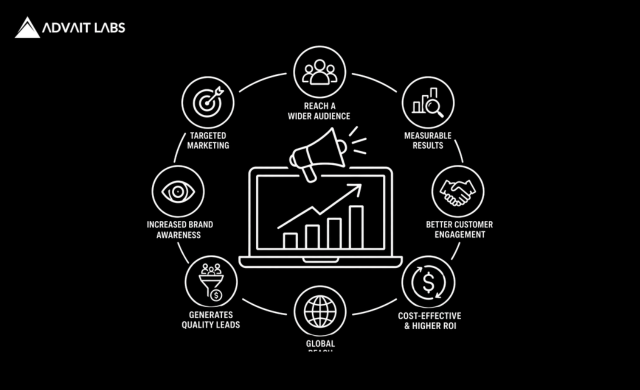
Customers today use digital channels throughout their buying journey. They search for products and services online, compare businesses, read reviews, visit websites, watch videos, interact with brands on social media, and increasingly use AI-powered search experiences to find information.
This makes a strong digital presence essential for businesses of almost every size and industry.
The benefits of digital marketing go beyond simply increasing website traffic. A well-planned digital marketing strategy can help businesses reach relevant audiences, generate qualified leads, improve customer engagement, increase conversions, and understand exactly how marketing activities contribute to business growth.
At Advait Technology Labs, we provide integrated digital marketing services including SEO, Google Ads, social media marketing, content marketing, website design and development, analytics, AEO, and GEO. Our approach combines technology, marketing strategy, and data to help businesses build measurable online growth.
What Are the Benefits of Digital Marketing?
Quick Answer
The major benefits of digital marketing include:
- Increased online visibility
- Better audience targeting
- More qualified leads
- Measurable marketing performance
- Improved customer engagement
- Cost-effective marketing opportunities
- Higher conversion potential
- Better customer insights
- Stronger brand awareness
- Greater market reach
- Improved customer retention
- More opportunities for personalization
The actual results depend on the business, industry, audience, strategy, competition, budget, and execution.
1. Reach a Larger Audience
One of the biggest benefits of digital marketing is the ability to reach customers beyond traditional geographic limitations.
A business can use:
- SEO
- Paid advertising
- Social media
- Email marketing
- Content marketing
- Video marketing
to reach audiences across different locations.
For example, an Indian software company can use SEO and content marketing to attract potential customers from different countries without opening physical offices in each market.
2. Reach the Right Audience
Digital marketing isn’t only about reaching more people.
It can help businesses reach more relevant people.
Platforms and digital marketing tools allow businesses to target audiences based on factors such as:
- Search intent
- Location
- Demographics
- Interests
- Online behavior
- Previous interactions
- Professional characteristics
For example, a local service business can focus its marketing on people searching for its services within specific locations.
3. Generate More Qualified Leads
Digital marketing can help businesses attract people who are already interested in their products or services.
SEO can target users actively searching for solutions.
Google Ads can target high-intent search queries.
Content marketing can attract people researching a problem.
Social media can introduce products to potential customers.
When these channels work together, businesses can create a more consistent lead-generation system.
4. Increase Brand Awareness
Customers are more likely to recognize and remember businesses they encounter consistently across relevant digital channels.
A business can build awareness through:
- Search results
- Social media
- Videos
- Blog content
- Paid advertisements
- Email campaigns
- Industry publications
A consistent digital presence can help establish familiarity before a customer is ready to make a purchase.
5. Measure Marketing Performance
Traditional marketing can sometimes make it difficult to determine exactly how many people interacted with an advertisement.
Digital marketing provides significantly more measurement opportunities.
Businesses can monitor metrics such as:
- Website traffic
- Clicks
- Impressions
- Engagement
- Leads
- Conversions
- Cost per lead
- Customer acquisition cost
- Revenue
- Return on ad spend
This allows marketing teams to evaluate performance and make data-informed decisions.
6. Improve Marketing ROI
Digital marketing can help businesses identify which channels and campaigns are contributing to business results.
For example, a company may discover that:
- SEO generates qualified organic leads.
- Google Ads generates faster leads.
- LinkedIn generates high-value B2B prospects.
- Email marketing generates repeat purchases.
The business can then allocate resources based on performance rather than assumptions.
However, digital marketing isn’t automatically inexpensive or profitable. Results depend on strategy, competition, execution, and ongoing optimization.
7. Build Long-Term Organic Visibility
SEO is one of the most important long-term components of digital marketing.
By creating useful content and improving technical website performance, businesses can build visibility for relevant search queries.
SEO can help businesses attract users searching for:
- Products
- Services
- Solutions
- Comparisons
- Questions
- Local businesses
Unlike paid advertising, organic visibility can continue generating traffic after individual content assets are published, although maintaining rankings requires ongoing optimization.
8. Improve Customer Engagement
Digital marketing creates multiple opportunities for businesses to interact with customers.
Customers can:
- Comment on social media
- Respond to emails
- Contact businesses through websites
- Ask questions
- Leave reviews
- Watch videos
- Participate in communities
These interactions can provide businesses with valuable feedback about customer needs and expectations.
9. Understand Customer Behavior
Digital analytics can reveal how users interact with your marketing channels.
Businesses can analyze:
- Which pages users visit
- How users discover the website
- Which content attracts attention
- Where visitors leave
- Which campaigns generate conversions
- Which devices customers use
These insights can help businesses improve their websites, content, advertising, and customer journeys.
10. Personalize Marketing Experiences
Digital channels can support more personalized communication.
For example, businesses can create different campaigns for:
- New visitors
- Existing customers
- Returning website visitors
- Leads
- High-value customers
Email marketing, remarketing, CRM systems, and audience segmentation can help businesses deliver more relevant messages.
11. Compete With Larger Businesses
Digital marketing can provide smaller businesses with opportunities to compete for attention in specific markets.
A smaller company can build authority through:
- High-quality content
- Local SEO
- Niche targeting
- Social media
- Paid search
- Strong website experiences
While larger businesses may have bigger budgets, focused digital strategies can help smaller companies compete within specific audiences and search markets.
12. Support Local Business Growth
Digital marketing isn’t only useful for global businesses.
Local businesses can use digital marketing to attract customers within specific geographic areas.
Local SEO, Google Business Profile optimization, location pages, reviews, and locally relevant content can help businesses improve their local online presence.
This is particularly valuable for:
- Healthcare providers
- Restaurants
- Retail businesses
- Educational institutions
- Professional services
- Home service companies
13. Improve Customer Retention
Digital marketing isn’t only about acquiring new customers.
It can also help businesses maintain relationships with existing customers.
Businesses can use:
- Email marketing
- CRM campaigns
- Remarketing
- Social media
- Loyalty campaigns
- Educational content
to remain connected with customers after the initial purchase.
14. Adapt Campaigns Quickly
Another advantage of digital marketing is flexibility.
Businesses can monitor campaigns and make changes to:
- Targeting
- Budget
- Ad creative
- Keywords
- Landing pages
- Content
- Calls to action
For example, if a paid campaign isn’t generating conversions, marketers can analyze the data and adjust the campaign rather than waiting until the end of a traditional advertising cycle.
15. Support Different Stages of the Customer Journey
Digital marketing can support customers from their first interaction with a brand through conversion and retention.
Awareness
Social media + Video + Display advertising
Discovery
SEO + Content + AEO + GEO
Consideration
Content + Reviews + Website + Remarketing
Conversion
PPC + Landing pages + CRO
Retention
Email + CRM + Social media
This connected approach can create a more consistent customer experience.
16. Improve Website Conversions
Driving traffic is only one part of digital marketing.
A website should also encourage visitors to take meaningful actions.
Conversion-focused strategies can improve:
- Contact forms
- Calls to action
- Landing pages
- Navigation
- Mobile experience
- Page speed
- Trust signals
- User journeys
This is why website design and digital marketing should work together.
17. Strengthen Your Brand’s Authority
Consistently publishing useful, accurate, and relevant content can help businesses demonstrate expertise.
Authority can be developed through:
- Educational articles
- Guides
- Case studies
- Expert content
- Original research
- Industry insights
- Helpful FAQs
A strong content strategy can support SEO while also helping customers understand why they should trust a business.
18. Prepare for AI-Powered Search
Search behavior is evolving beyond traditional search results.
Users increasingly interact with AI-powered systems to discover information, compare options, and ask questions.
This has increased interest in:
Answer Engine Optimization (AEO)
AEO focuses on structuring content to provide clear, useful answers to user questions.
Generative Engine Optimization (GEO)
GEO focuses on improving how brands and their content are understood and represented within generative search experiences.
These strategies work alongside traditional SEO rather than replacing it.
Final Thoughts
The benefits of digital marketing extend far beyond generating website traffic. A well-planned strategy can help businesses improve visibility, reach relevant audiences, generate qualified leads, understand customer behavior, increase conversions, strengthen brand authority, and make better marketing decisions.
The most effective digital marketing strategy isn’t necessarily the one with the largest number of channels. It is the one that connects the right channels to the right audience and measures their contribution to business goals.
At Advait Technology Labs, we combine SEO, paid advertising, social media, content, website development, analytics, AEO, and GEO to help businesses create a connected digital presence.
Visit Advait Technology Labs Today!
Frequently Asked Questions
1. What are the main benefits of digital marketing?
The main benefits include increased online visibility, better audience targeting, lead generation, measurable performance, customer engagement, improved conversions, customer insights, and opportunities to reach wider markets.
2. Is digital marketing suitable for small businesses?
Yes. Small businesses can use focused strategies such as local SEO, content marketing, social media, Google Ads, and conversion optimization to reach relevant audiences without needing to market to everyone.
3. How does digital marketing increase sales?
Digital marketing can help businesses attract high-intent prospects, nurture potential customers, improve website conversion rates, and use data to optimize campaigns that contribute to sales.
4. Which digital marketing strategy is best for a business?
There is no single strategy that works for every business. The right combination depends on the industry, target audience, competition, budget, and business objectives.
5. How can Advait Technology Labs help with digital marketing?
Advait Technology Labs provides SEO, Google Ads, social media marketing, content marketing, local SEO, website design and development, analytics, AEO, GEO, and conversion optimization to help businesses build and measure their digital growth.
