
AI-Powered Digital Marketing: The Complete Guide for Businesses
Digital marketing has always been driven by data. But artificial intelligence has fundamentally changed how that data is collected, interpreted, and acted upon — at a speed and scale that no human team can match manually.
AI-powered digital marketing is no longer a concept reserved for enterprise companies with large budgets. In 2026, businesses of all sizes — from multi-specialty hospitals in Hyderabad to e-commerce startups across India — are using AI-driven marketing strategies to reduce cost per acquisition, personalize customer experiences, and consistently outperform competitors still relying on manual campaign management.
Call 081792 08586 | Visit Advait technology Labs.
This guide explains exactly what AI-powered digital marketing means, how it differs from traditional approaches, what tools are involved, and how to build a strategy that delivers measurable ROI. If you are evaluating whether to partner with an AI marketing agency or upgrade your in-house capabilities, this is the most complete resource available.
| AI-powered digital marketing uses machine learning, predictive analytics, and automation to plan, execute, and continuously optimize campaigns across channels — search, social, email, and paid ads — without relying entirely on manual human decisions. The result is faster optimization, higher personalization, and significantly better return on marketing investment. |
What Is AI-Powered Digital Marketing?
AI-powered digital marketing refers to the use of artificial intelligence technologies — including machine learning, natural language processing (NLP), predictive analytics, and automation — to plan, execute, personalise, and optimize marketing campaigns across digital channels.
Unlike traditional digital marketing, where marketers manually analyse data and adjust campaigns at intervals, AI-driven marketing operates continuously. Algorithms monitor campaign performance in real time, identify patterns in customer behaviour, and make adjustments — to bids, creatives, audience segments, or content — without waiting for a scheduled review.
The term covers a broad range of applications:
• Automated bidding in Google Ads and Meta campaigns
• AI-generated or AI-assisted content for blogs, ads, and emails
• Predictive lead scoring in CRM systems
• Personalisation engines on websites and in email sequences
• Chatbots and conversational AI for lead qualification
• Sentiment analysis for social media monitoring
• Dynamic audience segmentation based on behavioural data
What makes AI marketing genuinely different from marketing automation (which simply follows pre-programmed rules) is its capacity to learn. AI systems improve their recommendations over time by processing more data — they get smarter as they run.
| Important distinction Marketing automation = rules-based (if X happens, do Y). AI marketing = learning-based (analyze patterns, predict outcomes, optimize without explicit rules). Both are useful; AI is more powerful for complex, high-volume campaigns. |
AI-Powered Marketing vs Traditional Digital Marketing: Key Differences
To understand the value of AI-driven marketing, it helps to compare it directly against the traditional approach most businesses still use.
| Capability | Traditional Marketing | AI-Powered Marketing |
| Audience targeting | Broad demographic segments | Hyper-personalised micro-segments |
| Campaign optimisation | Weekly/monthly manual review | Real-time automated adjustments |
| Content creation | Fully manual process | AI-assisted drafts + human refinement |
| Budget allocation | Fixed plans, reviewed quarterly | Dynamic spend redistribution daily |
| Data analysis | Retrospective reporting | Predictive insights + forward modelling |
| Lead scoring | Manual CRM qualification | Automated behavioural scoring |
| ROI measurement | Attribution gaps common | Multi-touch attribution + ROAS tracking |
The most important difference is not speed — it is the feedback loop. Traditional marketing relies on marketers reviewing data after the fact and making changes in the next campaign cycle. AI marketing closes this loop continuously, meaning campaigns improve while they are still running.
For businesses in competitive markets like healthcare, real estate, or e-commerce in India, this difference in loop speed can represent a significant advantage in cost per lead and conversion rate within just a few months.
The Core Components of an AI-Powered Marketing Strategy
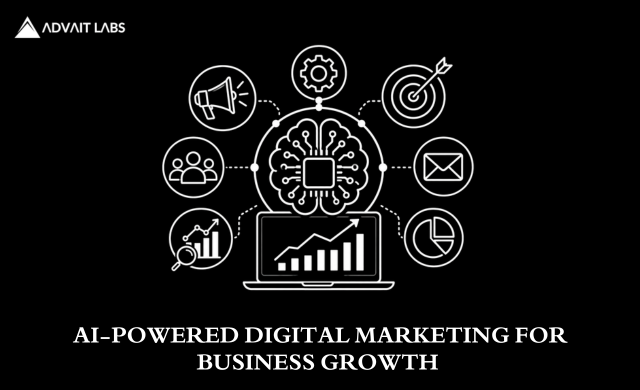
A mature AI-powered marketing strategy is built across five interconnected layers. Understanding each layer helps businesses evaluate where AI can add the most value based on their current capabilities and goals.
1. AI-Driven Audience Intelligence
AI tools analyse first-party data (your website visitors, CRM records, email subscribers) and third-party signals to build detailed audience profiles. These profiles go beyond demographics to include behavioural patterns, intent signals, purchase likelihood, and predicted lifetime value.
For a dental clinic, this might mean identifying website visitors who viewed the implant treatment page three times in a week and targeting them with a specific offer. For an e-commerce brand, it might mean predicting which customers are about to churn and triggering a retention campaign automatically.
• Google Analytics 4 predictive audiences, Meta Advantage+ audience, HubSpot AI contact scoringTools involved:
• Higher ad relevance, lower cost per click, better conversion rates from matched messagingBusiness impact:
2. Predictive Analytics and Campaign Planning
Before spending a single rupee on advertising, AI tools can model the likely performance of different campaign configurations — channel mix, audience segments, bid strategies, creative formats — based on historical data from your accounts and broader platform benchmarks.
This shifts campaign planning from intuition to data-backed probability. Agencies using predictive modelling can forecast ROAS, CPA, and traffic volumes with meaningful accuracy before launch, which reduces wasted budget during the testing phase significantly.
• Google’s Smart Bidding, Meta’s Budget Optimisation, Northbeam attribution modellingTools involved:
• Faster time to profitability, reduced budget waste, better cross-channel allocationBusiness impact:
3. AI Content Creation and Optimisation
Content is the fuel of every digital marketing channel. AI tools now assist with ideation, drafting, editing, SEO optimisation, and performance prediction for written content, ad copy, email subject lines, and social media posts.
It is critical to understand that the best AI content strategies combine machine efficiency with human expertise. AI generates at scale; human marketers ensure accuracy, brand voice, and strategic alignment. For regulated industries like healthcare, human editorial oversight is non-negotiable.
• Surfer SEO for on-page optimisation, Jasper for ad copy, ChatGPT for ideation, Google’s Performance Max for creative testingTools involved:
• Faster content production, better keyword coverage, improved ad creative performanceBusiness impact:
4. Marketing Automation and Personalisation
AI-powered personalisation goes beyond inserting a customer’s name in an email. It adapts the entire message — content, offer, timing, and channel — based on where the individual is in their buying journey and what they have previously responded to.
For a healthcare client, this might mean sending a post-consultation follow-up sequence automatically, or triggering a review request exactly 48 hours after a patient’s appointment rather than on a fixed monthly schedule.
• HubSpot workflows, Salesforce Einstein, Intercom Fin AI, WhatsApp Business API automationTools involved:
• Higher email open and reply rates, improved patient/customer retention, lower churnBusiness impact:
5. Real-Time Performance Optimisation
The most visible benefit of AI in paid digital marketing is real-time bid and budget optimisation. Platforms like Google and Meta use machine learning to adjust bids hundreds of times per day, factoring in signals like device type, time of day, search context, and user history that no human could process manually.
Beyond platform-level AI, advanced agencies layer third-party tools that monitor cross-channel performance, flag anomalies (e.g., a sudden drop in conversion rate), and reallocate budget between campaigns automatically based on efficiency targets.
• Google Performance Max, Meta Advantage+, Triple Whale, OptmyzrTools involved:
• Lower CPA, higher ROAS, faster response to market changesBusiness impact:
AI Marketing Tools: What Agencies Actually Use in 2025
The AI marketing technology landscape is large and expanding rapidly. The table below covers the most widely used platforms in active client work across SEO, paid media, CRM, and content — categorised by function.
| AI Tool Category | Key Platforms / Tools | What It Does for Your Campaigns |
| AI Content & SEO | Surfer SEO, Jasper, ChatGPT (GPT-4o) | Content generation, topic clustering, NLP optimisation |
| Paid Ads Automation | Google Performance Max, Meta Advantage+ | Smart bidding, audience expansion, creative testing |
| CRM & Marketing Automation | HubSpot (AI features), Salesforce Einstein | Lead scoring, pipeline automation, email sequencing |
| Social Media AI | Sprinklr, Hootsuite OwlyWriter | Content scheduling, sentiment monitoring, brand tracking |
| Analytics & Attribution | Northbeam, Triple Whale, GA4 (predictive) | Multi-touch attribution, predictive audiences, LTV forecasting |
| Chatbots & Engagement | Intercom (Fin AI), Drift | Automated lead qualification, 24/7 patient/customer support |
| Visual & Creative AI | Adobe Firefly, Canva Magic Studio | Ad creative generation, image editing, brand consistency |
A note on tool selection: the best AI marketing stack depends on your industry, budget, and the channels that drive the most value for your business. For healthcare clients in India, WhatsApp Business automation, Google Ads smart bidding, and localised SEO content consistently deliver the strongest results.
How AI-Powered Marketing Delivers Higher ROI: A Practical Breakdown
Businesses consistently ask: why does AI marketing cost more upfront than standard agency retainers, and how does that cost justify itself?
The answer lies in compounding efficiency gains across three dimensions.
Dimension 1: Cost Efficiency in Paid Advertising
Manual paid campaigns typically waste 20–35% of budget on underperforming segments, irrelevant placements, or stale creatives that were not caught and paused quickly enough. AI-driven campaigns reduce this waste through continuous optimisation.
In practice, clients moving from manually managed to AI-optimised Google Ads campaigns see cost per lead reductions of 25–45% within the first three months — simply from removing wasted spend and improving audience targeting precision.
Dimension 2: Speed of Learning and Iteration
A human marketing team might review campaign performance weekly and implement changes over two to three days. An AI-driven campaign makes micro-adjustments continuously — testing different ad variations, audience signals, and bid strategies simultaneously rather than sequentially.
This parallel testing and learning dramatically compresses the optimisation timeline. Campaigns that would take six months to reach peak efficiency under manual management can reach similar efficiency in six to eight weeks with AI-driven approaches.
Dimension 3: Personalisation at Scale
Personalised marketing messages consistently outperform generic ones — email open rates improve by 26% on average with personalised subject lines, and conversion rates on personalised landing pages can be two to three times higher than generic equivalents.
Delivering personalisation manually is only feasible for small audiences. AI makes it possible for businesses with hundreds of thousands of contacts to deliver individually relevant experiences across email, ads, and website content simultaneously.
| Healthcare example from Advait Labs client workAfter implementing AI-driven audience segmentation and automated follow-up sequences for a Hyderabad specialty clinic, appointment bookings increased by 38% within 90 days — with no increase in total ad spend. The improvement came entirely from smarter targeting and faster lead nurturing, not from spending more. |
How to Choose an AI-Powered Digital Marketing Agency
Not every agency that claims to use AI actually does. The term has become a marketing phrase rather than a technical description in many cases. Here is a framework for evaluating whether an agency truly operates with AI-driven approaches.
Questions to ask before signing a retainer
1. Which AI tools do you use, and how are they integrated into campaign management?
2. Can you show me examples of AI-generated audience insights or predictive reports from past campaigns?
3. How does your AI-driven approach differ from standard Google Smart Bidding or Meta Advantage+?
4. What human oversight processes exist to validate AI recommendations before they are implemented?
5. How do you measure and report ROI, and which attribution model do you use?
6. Do you have experience in my specific industry, and can you share relevant case study data?
Red flags to watch for: agencies that cannot name specific tools, claim AI handles everything without human input, or focus exclusively on vanity metrics (impressions, followers) rather than business outcomes (leads, revenue, cost per acquisition).
Building an AI Marketing Strategy: Where to Start
For businesses new to AI-powered marketing, the practical starting point is not technology — it is data. AI tools are only as good as the data available to them.
Step 1: Audit your existing data infrastructure
Before deploying AI tools, ensure you have clean, structured data in your CRM, accurate conversion tracking on your website, and a Google Analytics 4 property configured correctly. Poor data quality produces poor AI recommendations.
Step 2: Identify your highest-value customer segment
AI performs best when it has a clear objective. Define which customer segment (or patient type, for healthcare) generates the most revenue per acquisition, and focus the initial AI marketing effort on acquiring more of them.
Step 3: Start with paid media AI before content AI
The fastest, most measurable ROI from AI marketing comes from paid channels — Google Ads smart bidding and Meta Advantage+ — because performance data is immediate and attribution is direct. Start here before investing in AI content generation.
Step 4: Build automation into your lead nurturing
Once you are generating leads efficiently, the next highest-value application is automated nurturing — email and WhatsApp sequences that guide leads toward conversion without requiring manual follow-up from your team.
Step 5: Layer in AI content and SEO over 90 days
AI-assisted SEO content builds long-term organic traffic, but it compounds over months rather than delivering immediate returns. Begin publishing AI-informed pillar content in month one and track keyword ranking progress over a 90–180 day window.
Frequently Asked Questions
What is AI-powered digital marketing?
AI-powered digital marketing uses machine learning, predictive analytics, and automation to plan, execute, and continuously optimize marketing campaigns across digital channels — including search, social media, email, and paid advertising — in real time and at scale.
How does AI marketing differ from marketing automation?
Marketing automation follows pre-programmed rules (if someone downloads a guide, send a follow-up email). AI marketing learns from data and makes independent decisions — for example, adjusting ad bids hundreds of times per day based on conversion probability signals that no human could monitor manually.
How long does it take to see results from AI-powered marketing?
Paid media AI (smart bidding, automated audience targeting) typically shows measurable improvement within 4–8 weeks, as the algorithm needs sufficient conversion data to optimise effectively. Content and SEO strategies compound over 3–6 months. Combined, a full AI marketing programme typically demonstrates clear ROI within the first quarter.
Is AI-powered marketing suitable for small businesses and clinics?
Yes. AI marketing is particularly well-suited to businesses with limited marketing teams because it automates tasks that would otherwise require dedicated headcount. For clinics and small businesses, the most cost-effective entry points are AI-driven Google Ads management and automated patient follow-up sequences.
What does an AI-powered digital marketing agency actually do?
Beyond standard campaign management, an AI-powered agency applies machine learning tools to audience segmentation, predictive campaign planning, creative testing, real-time bid optimisation, lead scoring, and personalised nurturing — and delivers reporting that connects every activity to business outcomes rather than just platform metrics.
| Ready to move from traditional to AI-powered marketing? Advait Technology Labs is Hyderabad’s specialist AI-driven digital marketing consultancy. We work with healthcare businesses, clinics, hospitals, and growth-stage companies to build data-driven marketing systems that deliver measurable ROI. Book a free strategy consultation |
