

ERP vs CRM: What’s the Difference?
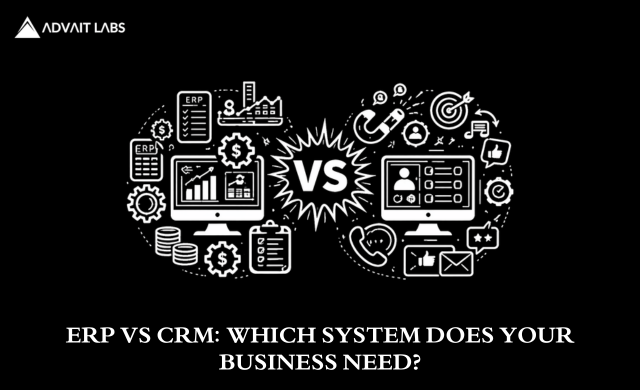
ERP vs CRM is one of the most common questions businesses ask when choosing the right technology to manage operations and customer relationships. While both systems help organizations improve efficiency and decision-making, they serve very different purposes.
For growing businesses in Hyderabad, understanding the difference between ERP and CRM systems is essential before investing in digital infrastructure. Choosing the right platform can streamline operations, improve customer experience, and support long-term scalability.
At Advait Labs, we work with businesses that want clarity when selecting technology solutions. Many organizations initially struggle to understand whether they need an ERP system, a CRM system, or both. This guide explains everything in simple terms so business owners can make informed decisions.
If you’re exploring ERP or CRM solutions for your Hyderabad business, book a consultation with Advait Labs to discuss the right approach for your growth strategy.
Understanding ERP vs CRM
When discussing ERP vs CRM, it’s important to understand that both systems manage data and processes, but they focus on different areas of a business.
- ERP (Enterprise Resource Planning) manages internal business operations.
- CRM (Customer Relationship Management) manages interactions with customers and prospects.
Both systems improve efficiency but address different business needs.
What Is ERP?
ERP stands for Enterprise Resource Planning, a system designed to manage and integrate core business processes within an organization.
ERP systems centralize information across departments such as:
- Finance and accounting
- Inventory management
- Procurement
- Supply chain operations
- Human resources
- Project management
Instead of multiple disconnected tools, ERP systems allow companies to manage everything from one integrated platform.
Why ERP Is Important for Businesses
For companies in Hyderabad experiencing rapid growth, ERP systems help ensure that internal operations remain organized and scalable.
Key benefits include:
- Centralized data management
- Improved operational efficiency
- Better financial visibility
- Reduced manual processes
- Stronger coordination between departments
ERP systems are particularly useful for businesses that manage inventory, complex operations, or multiple departments.
What Is CRM?
CRM stands for Customer Relationship Management, a system designed to help businesses manage relationships with customers and prospects.
CRM platforms focus on customer-related processes such as:
- Lead management
- Sales tracking
- Customer communication
- Marketing campaigns
- Customer support
The goal of CRM is to improve how businesses attract, convert, and retain customers.
Why CRM Matters for Businesses
For businesses in Hyderabad competing for attention in crowded markets, CRM systems help improve customer engagement and sales performance.
Benefits include:
- Organized customer data
- Improved lead management
- Better communication tracking
- Stronger sales pipeline visibility
- Improved customer experience
CRM systems are commonly used by sales teams, marketing departments, and customer service teams.
Key Differences Between ERP and CRM
Understanding ERP vs CRM becomes easier when comparing their core functions.
| Feature | ERP | CRM |
| Focus | Internal operations | Customer relationships |
| Primary users | Finance, operations, HR | Sales, marketing, support |
| Main goal | Streamline business processes | Improve customer engagement |
| Data managed | Financial, operational, supply chain | Leads, contacts, interactions |
| Business impact | Operational efficiency | Revenue growth |
In simple terms, ERP manages how a business runs internally, while CRM manages how a business interacts with customers.
ERP vs CRM: Which One Does Your Business Need?
The choice between ERP and CRM depends on your business priorities.
Businesses That Benefit from ERP
ERP systems are useful for organizations that need to manage complex internal operations.
Examples include:
- Manufacturing companies
- Retail and distribution businesses
- Companies managing supply chains
- Businesses with multiple departments
ERP helps these organizations maintain efficiency as they grow.
Businesses That Benefit from CRM
CRM systems are ideal for businesses that rely heavily on customer relationships.
Examples include:
- Service-based businesses
- Sales-driven organizations
- Consulting firms
- Marketing agencies
- Technology companies
CRM tools help teams manage leads and build stronger customer relationships.
Can Businesses Use ERP and CRM Together?
Yes, many organizations use both ERP and CRM systems together.
When integrated properly, they create a powerful digital ecosystem.
Example Workflow
- CRM captures leads and manages sales opportunities.
- When a deal closes, ERP manages order processing, billing, and delivery.
- Customer data flows seamlessly between systems.
This integration allows businesses to maintain a complete view of operations and customer interactions.
Why Businesses Are Adopting ERP and CRM Systems
As businesses grow, manual processes become inefficient.
ERP and CRM systems help businesses:
- Improve operational efficiency
- Strengthen customer engagement
- Manage growth effectively
- Make data-driven decisions
Technology adoption is now a key competitive advantage in the local market.
Common Mistakes Businesses Make When Choosing Between ERP vs CRM
Many businesses make decisions without fully understanding their needs.
Common mistakes include:
- Choosing ERP when they actually need CRM
- Implementing systems without clear workflows
- Ignoring employee adoption and training
- Overcomplicating systems early on
- Not planning for scalability
Working with experienced consultants helps businesses avoid these issues.
How Advait Labs Helps Businesses Choose the Right Systems
At Advait Labs in Hyderabad, the approach focuses on understanding business goals before recommending technology solutions.
Rather than forcing businesses into complex systems, the goal is to identify solutions that:
- Align with business processes
- Improve operational efficiency
- Support long-term scalability
- Integrate with existing tools
Technology should simplify operations—not create additional confusion.
If your organization is evaluating ERP vs CRM, connect with Advait Labs in Hyderabad to explore the right digital solutions for your business.
Frequently Asked Questions (FAQs)
1. What is the main difference between ERP vs CRM?
ERP manages internal business processes such as finance, inventory, and operations, while CRM focuses on managing customer relationships and sales activities.
2. Do small businesses in Hyderabad need ERP or CRM?
Small businesses often start with CRM to manage customer relationships. ERP becomes useful as operations grow more complex.
3. Can ERP and CRM be integrated?
Yes. Many organizations integrate ERP and CRM systems to create a seamless flow of customer and operational data.
4. Which system improves sales performance?
CRM systems directly support sales teams by tracking leads, managing pipelines, and improving customer communication.
5. When should a company implement ERP?
ERP systems are most useful when a company manages multiple departments, complex operations, or large amounts of operational data.
