

How to Find and Clean Up Toxic Backlinks
A backlink is not automatically harmful just because it comes from a low-authority or unfamiliar website. The real problem is a pattern of unnatural links created to manipulate rankings, such as paid links, link schemes, or large-scale spam.
This distinction matters because backlink cleanup can become counterproductive if you remove or disavow links simply because a third-party tool labels them “toxic”. Google says its systems can ignore many spammy links automatically, and the disavow tool is intended for advanced cases.
For businesses in Hyderabad, a careful backlink audit can help identify genuine link-related risks without wasting time on harmless mentions. Advait Labs can help businesses review backlink profiles, assess technical SEO signals, and build a cleaner search strategy.
Need help auditing your website’s backlink profile? Talk to Advait Labs about a practical SEO audit focused on real risks, not arbitrary toxicity scores.
What Are Toxic Backlinks?
“Toxic backlink” is an SEO industry term, not a Google classification. It generally refers to links that may be manipulative, clearly spammy, or part of an unnatural linking pattern.
Examples include:
- Paid links that pass ranking credit without appropriate qualification
- Links from private blog networks created mainly to manipulate rankings
- Large-scale automated directory, profile, forum, or comment links
- Sitewide links with heavily optimised anchor text
- Links placed in hacked or compromised pages
- Obvious link schemes involving excessive exchanges or other manipulative tactics
Google’s spam policies are a better reference point than an automated “toxic score”.
A random link from a poor-quality website is not necessarily a problem. Relevance, context, intent, and the overall pattern matter more than a single domain metric.
How to Find Toxic Backlinks
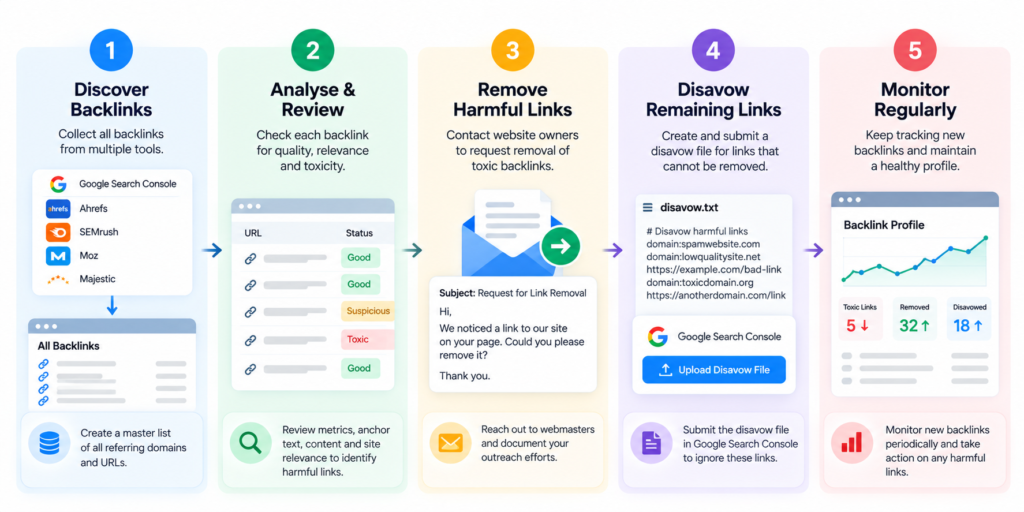
1. Start with Google Search Console
Open the Links report in Google Search Console to review external links Google associates with your website. Look at top linking sites, top linked pages, and anchor text patterns where available.
Search Console is useful, but it is not a complete backlink database. Third-party tools can discover additional links and provide useful filtering and historical data.
2. Export and Consolidate Backlink Data
Combine exports from Search Console and your backlink platform into one spreadsheet. Remove duplicates and record:
- Linking domain and URL
- Target page
- Anchor text
- Link type
- First-seen date
- Follow, nofollow, sponsored, or UGC attributes, where available
- Relevance and context
- Action taken
This makes it easier to separate genuine risks from links that simply look unfamiliar.
3. Review Links Manually
For each suspicious backlink, ask:
- Does the linking page appear to exist for users?
- Is the link relevant to the page it points to?
- Does the page look like part of a link network?
- Is the anchor text unnaturally keyword-heavy?
- Was the link likely paid for or created for SEO manipulation?
- Does the site contain large amounts of thin or autogenerated content?
Do not label a backlink toxic only because the domain has a low Domain Authority, low Domain Rating, low traffic, or a high third-party spam score.
4. Check for Manual Actions
In Google Search Console, open the Manual Actions report. If Google has identified an issue involving unnatural links, this is a much stronger reason to investigate the backlink profile carefully.
How to Clean Up Toxic Backlinks
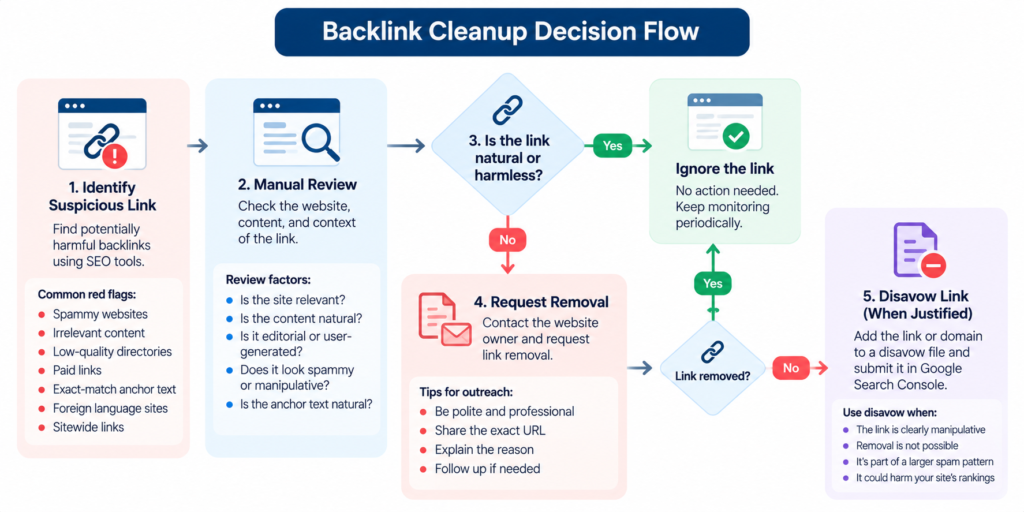
Step 1: Try Manual Removal First
If a genuinely harmful link was deliberately created and the webmaster can remove it, request removal. Keep a record of URLs, contact attempts, and responses.
You do not need to contact hundreds of unrelated websites just because a tool has flagged their links.
Step 2: Fix the Underlying Link-Building Problem
If your site or an agency previously created manipulative links, stop the activity. Review paid placements, automated submissions, link exchanges, private networks, and overly aggressive anchor-text campaigns.
Cleaning the backlink profile without addressing the strategy that created the links leaves the underlying problem in place.
Step 3: Use Google’s Disavow Tool Only When Appropriate
The Google Disavow Tool allows site owners to tell Google which backlinks they do not want associated with their site. It is an advanced tool and should be used cautiously.
Google recommends considering disavowal when you have a considerable number of spammy, artificial, or low-quality links and those links have caused, or are likely to cause, a manual action.
A disavow file is a plain text file. For example:
domain:example-spam.com
Only include domains or URLs you have a clear reason to disavow. Do not create a huge file from every low-quality backlink you can find.
Step 4: Monitor Rather Than Expecting an Instant Recovery
Backlink cleanup does not guarantee an immediate ranking increase. Google may already be ignoring some links, and disavowing links is not a ranking reset button.
Continue monitoring Search Console, organic traffic, rankings, manual actions, and important landing pages.
A Practical Backlink Audit Checklist
- Export backlinks from reliable sources
- Consolidate and remove duplicate records
- Identify unnatural patterns
- Review suspicious links manually
- Separate genuinely risky links from merely low-quality links
- Check Google Search Console for manual actions
- Request removal of clearly manipulative links where practical
- Document your outreach and decisions
- Use disavow only when Google’s guidance supports it
- Monitor organic performance after cleanup
Backlinks vs Indexing: What Is the Difference?
Backlinks and technical indexing are related to SEO, but they solve different problems.
A backlink audit does not replace checking whether important pages can be crawled and indexed. If a page is not appearing in Google, use the URL Inspection Tool to check its indexing status, crawlability, canonical signals, and other relevant information.
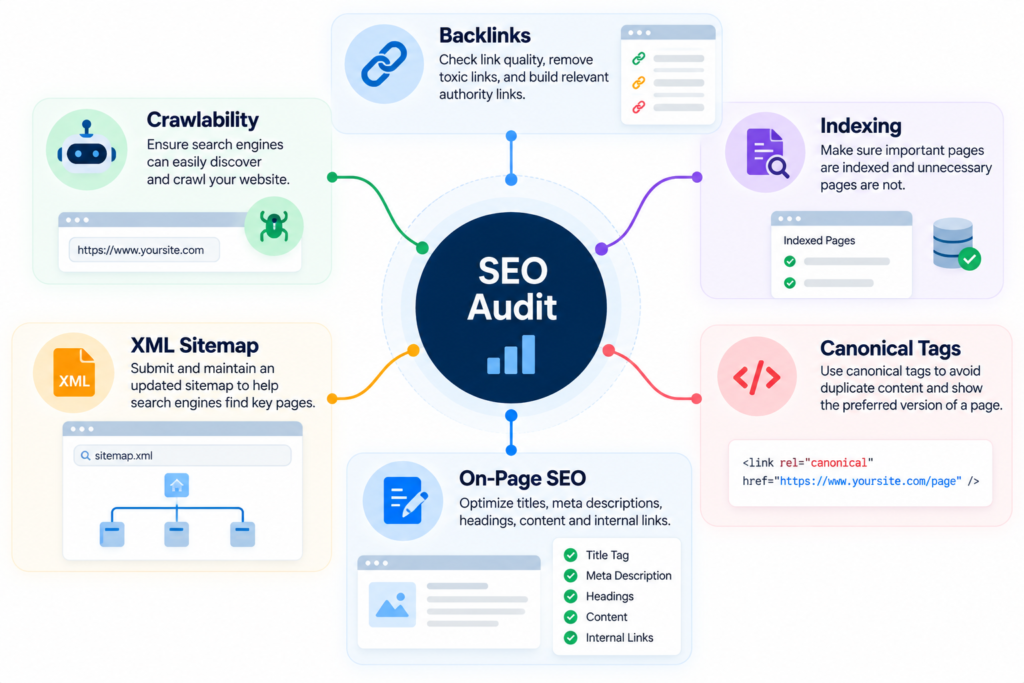
Similarly, an XML sitemap helps search engines discover important URLs. A noindex tag tells search engines not to index a page. Duplicate content and canonical issues are separate technical SEO concerns.
Plagiarism is also different. Copied content may create quality and originality concerns, but simply finding a backlink from a website that copied your content does not mean that every link from that site should be disavowed.
This is why a good technical SEO audit looks at backlinks alongside crawlability, indexing, internal linking, duplicate content, sitemaps, and other site signals rather than treating every issue as a backlink problem.
Common Backlink Mistakes to Avoid
- Disavowing every low-authority domain
- Trusting a third-party “toxic score” without manual review
- Assuming a sudden ranking drop was caused by backlinks
- Paying websites to remove links without assessing the risk
- Ignoring manual actions
- Expecting disavowal to produce instant ranking gains
- Building new manipulative links after completing cleanup
When Should You Consider a Professional Backlink Audit?
A deeper review can make sense when:
- Your website has a large or unusually complex backlink profile
- A previous SEO campaign used aggressive link building
- You have received a manual action related to unnatural links
- You see suspicious anchor-text patterns
- Your site has experienced an unexplained organic decline and other causes are being investigated
- You acquired a domain with an unknown SEO history
For larger websites, agencies, or businesses operating in competitive Hyderabad search markets, a documented audit can be more useful than repeatedly running automated toxicity reports.
Conclusion
Cleaning toxic backlinks is not about making every backlink look perfect. It is about identifying genuine patterns of manipulation, addressing problems you can control, and using Google’s tools carefully when stronger action is justified.
Start with Google Search Console, supplement it with reliable backlink data, review suspicious links in context, and document every decision. Most importantly, do not confuse a low-quality link with a harmful one.
For businesses in Hyderabad, Advait Labs can support a broader SEO approach that combines backlink analysis with technical audits, indexing checks, on-page optimisation, and sustainable organic growth.
Looking for professional SEO support in Hyderabad? Contact Advait Labs to review your backlink profile and identify practical opportunities to strengthen your website’s organic visibility.
FAQ
What are toxic backlinks?
Toxic backlinks are links that may be spammy, manipulative, or part of an unnatural linking pattern. The term is an SEO industry label, not a specific Google classification.
How can I find toxic backlinks?
Start with Google Search Console’s Links report and supplement it with a reputable backlink analysis tool. Review suspicious links manually instead of relying only on automated toxicity scores.
Should I disavow every spammy backlink?
No. Google says many spammy links can be ignored automatically. Disavowal is an advanced option for cases involving substantial artificial or low-quality links, particularly where a manual action has occurred or is likely.
Can toxic backlinks hurt Google rankings?
Manipulative links can violate Google’s spam policies and may create ranking or manual-action risks. However, a single low-quality backlink does not automatically cause a ranking drop.
How often should I audit backlinks?
There is no universal schedule. Consider periodic audits for active websites and perform a deeper review after a major SEO campaign, site acquisition, suspicious link-building activity, or unexplained organic decline.
Does disavowing backlinks improve rankings immediately?
No. Disavowal is not a guaranteed or instant ranking fix. Google may already be ignoring some links, and other SEO factors can influence organic performance.
