

Entity SEO: How AI Search Decides Which Brands to Cite
AI search is changing how people discover businesses. Instead of scanning a list of links, users may ask a question and receive a synthesized answer with links to supporting sources. That creates a new visibility question for brands: not only “Can my website rank?” but also “Can AI systems understand my brand well enough to mention and cite it?”
This is where entity SEO matters. Entity SEO helps search systems connect your brand, services, expertise, website, people, locations, and other trusted references into a clearer picture. Advait Labs can approach this as part of a broader SEO and AI-search strategy, alongside technical SEO, content, and digital visibility.
If you want your brand to be easier for search engines and AI systems to understand, talk to Advait Labs about an SEO and AI-search visibility strategy.
What Is Entity SEO?
Entity SEO is the practice of helping search engines clearly identify and understand a real-world entity such as a company, product, person, organization, or location.
Traditional SEO often starts with keywords. Entity SEO adds another layer: meaning and relationships.
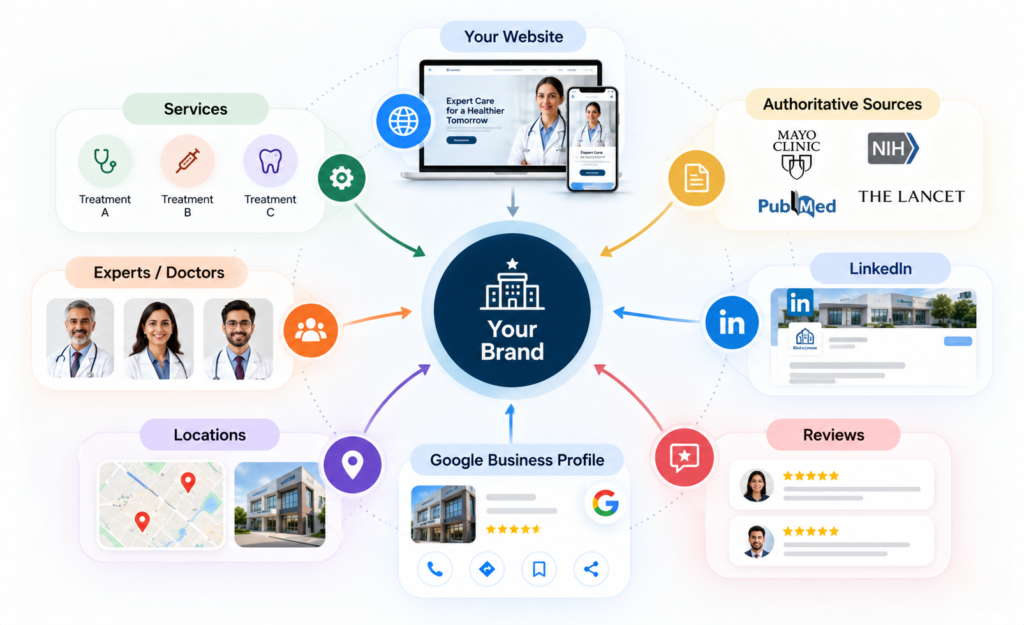
For example, a search system should be able to connect the brand with its website, services, locations, people, and relevant content.
The goal is not to insert the brand name everywhere. It is to create a consistent, useful web presence that makes the brand easier to identify and understand.
How AI Search Chooses Sources to Cite
There is no public Google formula called an “AI citation score.” Google has also not published a rule saying that a particular schema type or authority threshold guarantees a citation.
Google explains that AI features can use web content to generate responses and provide links to supporting pages. It also says foundational SEO practices remain relevant to AI features.
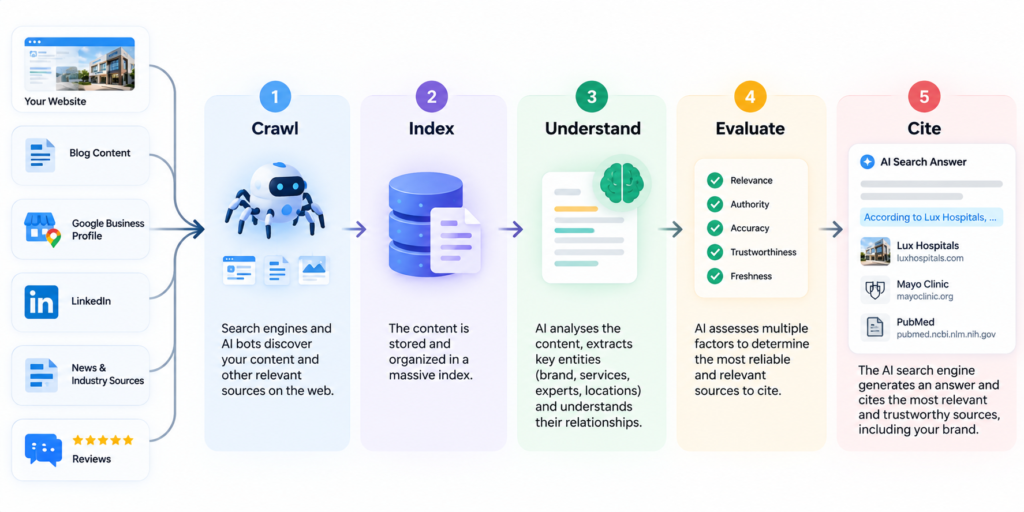
A useful practical framework is to think about five questions.
1. Can AI Search Discover and Access the Source?
Search engines need to crawl and index a page before it can contribute to search visibility.
Check that:
- Important pages are crawlable.
- Valuable URLs are not unintentionally blocked.
- Important pages do not have an accidental noindex directive.
- Your XML sitemap contains important canonical URLs.
- Internal links help crawlers discover key content.
2. Is the Brand Clearly Defined?
A company name appearing on a website is not the same as a clearly defined brand entity.
Make important information easy to understand:
- Brand or organization name
- Main services
- Locations
- About information
- Relevant people or experts
- Contact details
- Official website
Structured data should accurately support visible information. It is not a shortcut for getting an AI citation.
3. Does the Page Directly Answer the Query?
AI search is not simply looking for pages that repeat a keyword. The content needs to fit the question.
A page targeting “How does entity SEO help a brand appear in AI search?” should answer that question directly rather than simply repeat the keyword.
This is why search intent still matters. Content written mainly to repeat keywords is less useful than content that resolves the user’s question.
4. Are Important Brand Signals Consistent?
A brand becomes easier to understand when important information agrees across its digital presence.
Review your:
- Website
- Google Business Profile
- LinkedIn company page
- Relevant industry profiles
- Author or expert pages
- Press or partner mentions
Core business facts should remain accurate and consistent across important sources.
5. Does the Source Provide Something Worth Citing?
A page has a stronger reason to be referenced when it provides original explanations, useful data, expert context, firsthand experience, clear examples, or information that directly answers the user’s question.
Entity SEO and Technical SEO Work Together
Entity optimization cannot compensate for basic technical problems.
Check Indexing in Google Search Console
Use the URL Inspection Tool to check important pages for indexing and technical issues.
Prioritize your homepage, service pages, location pages, About page, expert pages, and high-value blog posts.
Review Your XML Sitemap
An XML sitemap helps search engines discover important URLs. Keep it focused on canonical, indexable pages and submit it through Search Console.
See Google’s sitemap documentation for implementation guidance.
Check Noindex Tags
A noindex directive can prevent a page from appearing in Google Search. That may be intentional for certain pages, but an accidental noindex can hide valuable content.
See Google’s documentation on blocking search indexing.
Manage Duplicate Content
When multiple URLs contain substantially similar content, search engines may need to determine which version should be indexed.
Review canonical tags, redirects, URL parameters, and duplicate pages. Google’s duplicate URL guidance explains canonicalization and consolidation.
Check Content Originality
Plagiarism or similarity checks can be useful editorial quality controls, especially when several writers or AI-assisted workflows are involved.
But do not treat a plagiarism percentage as a Google ranking score. The objective is original, accurate, useful content—not simply a low similarity number.
How to Improve Entity SEO for AI Search
Build a Clear Brand Information Layer
Create strong About, service, location, contact, and expert pages. Clearly explain what the business does and who it serves.
Create Connected Topic Clusters
Build groups of useful content around important subjects instead of publishing disconnected posts.
For an SEO brand, useful clusters could cover entity SEO, AI search optimization, technical SEO, local SEO, AI Overviews, content strategy, Search Console, and structured data.
Link related pages naturally so users and crawlers can understand the relationships between them.
Strengthen First-Party Expertise
Publish practical examples, original insights, process explanations, case studies where appropriate, and expert-led content.
Avoid unsupported statements such as “Google always cites brands with schema” or “this tactic guarantees AI visibility.”
Keep Business Information Consistent
Regularly review your website and major external profiles for outdated names, services, locations, descriptions, and contact details.
Measure More Than Rankings
Track organic impressions and clicks in Search Console, branded searches, referral traffic, indexed pages, and relevant mentions.
If you want to evaluate how your website is prepared for entity SEO and AI search, connect with Advait Labs for a practical SEO and visibility assessment.
Entity SEO vs Traditional SEO
Traditional SEO and entity SEO are not competing strategies.
Traditional SEO focuses on relevance, technical accessibility, links, content, search intent, and rankings. Entity SEO adds greater focus on relationships around a brand or subject.
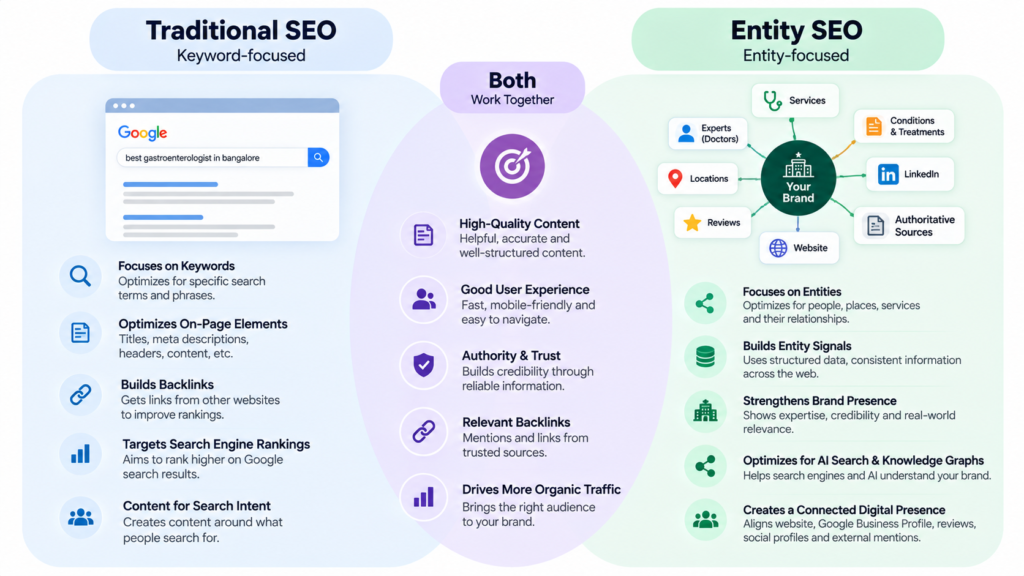
A simple way to frame the difference is:
- Traditional SEO: “Can this page be found and ranked for this query?”
- Entity SEO: “Is there enough clear, consistent and useful information for this brand or subject to be understood correctly?”
AI search makes the second question more important because generated answers can combine information from multiple sources.
What Brands Should Avoid
Trying to force AI citations can lead to poor SEO decisions.
Avoid:
- Keyword stuffing
- Repeating the brand name unnaturally
- Thin or near-duplicate location pages
- Schema that does not match visible content
- Unsupported expertise or authority claims
- Copying competitor content
- Treating AI-generated text as automatically accurate
- Removing useful information just to make pages shorter
A Practical Entity SEO Checklist
Before publishing or optimizing a page, ask:
- Is the page crawlable and indexable?
- Is the intended canonical URL clear?
- Does the page answer a specific search intent?
- Is the brand clearly identified?
- Are important facts accurate and consistent?
- Does the content add useful information?
- Are related pages internally linked?
- Is structured data accurate and relevant?
- Are duplicate URLs handled properly?
- Has the page been checked in Google Search Console?
These steps do not guarantee an AI citation. They create a stronger foundation for search systems to discover, understand, evaluate, and potentially reference your content.
Why Entity SEO Matters for the Future of Search
Search is becoming more conversational. Users increasingly ask complete questions, while AI-powered search experiences can synthesize information from multiple web sources.
That does not make traditional SEO obsolete. It makes clarity more important.
Brands need to be technically accessible, clearly defined, useful on their own websites, and consistently represented across relevant parts of the web.
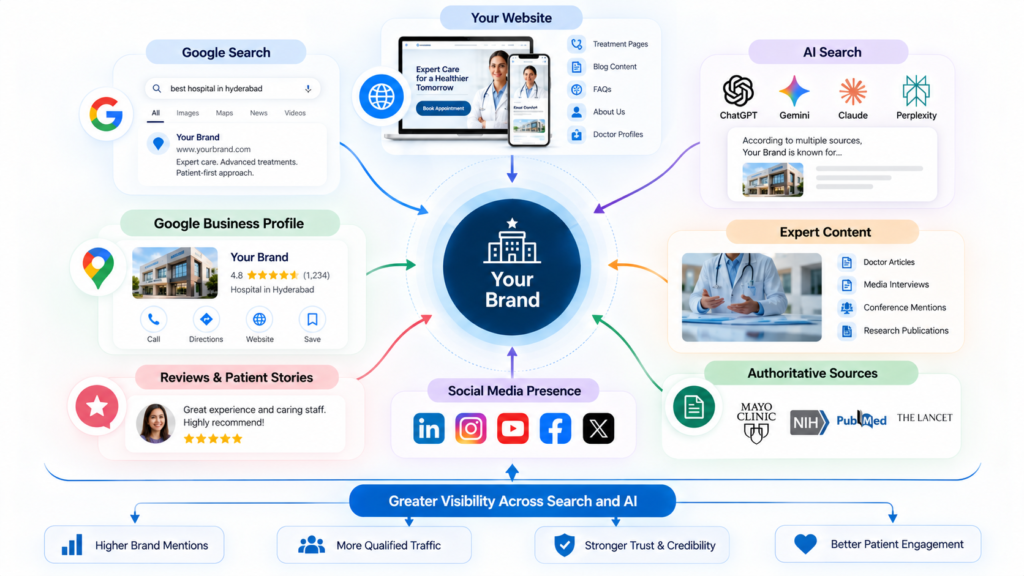
For businesses in Hyderabad, entity SEO can be treated as part of a broader digital visibility strategy rather than as a separate trick for AI search.
Looking to improve your brand’s visibility across Google and AI-powered search? Advait Labs helps businesses in Hyderabad build stronger SEO foundations, useful content, and AI-search visibility strategies. Contact Advait Labs to discuss your requirements.
Frequently Asked Questions About Entity SEO
What is entity SEO?
Entity SEO is the process of helping search engines understand a brand, organization, person, product, or other identifiable entity and its relationships with relevant information across the web.
Does entity SEO help with AI search?
Entity SEO can support clearer brand understanding by improving information consistency, technical accessibility, content quality, and connections between related topics. However, no SEO technique guarantees that an AI system will cite a particular brand.
How can a brand get cited in AI search?
There is no guaranteed method. Brands can improve their chances by creating useful, original content, maintaining technically accessible pages, clearly describing their organization, using accurate structured data, and maintaining consistent information across relevant sources.
Does structured data guarantee AI citations?
No. Structured data can help search engines understand information, but it does not guarantee rankings, AI Overviews visibility, or citations.
How do I check whether my website is indexed?
Google Search Console’s URL Inspection Tool can be used to check individual URLs and identify indexing-related issues. You should also review your overall index coverage and technical SEO setup.
Is entity SEO the same as traditional SEO?
No, but they overlap. Traditional SEO focuses on areas such as relevance, technical SEO, content, links, and search intent. Entity SEO places additional emphasis on helping search systems understand entities and their relationships.
What is the difference between entity SEO and GEO?
Entity SEO focuses on making entities and their relationships clear to search systems. Generative Engine Optimization, or GEO, is a broader term commonly used for optimizing content and brand visibility in AI-generated search experiences. The two approaches can work together.
