

Ad Fatigue: Signs Your Campaign Needs a Creative Refresh
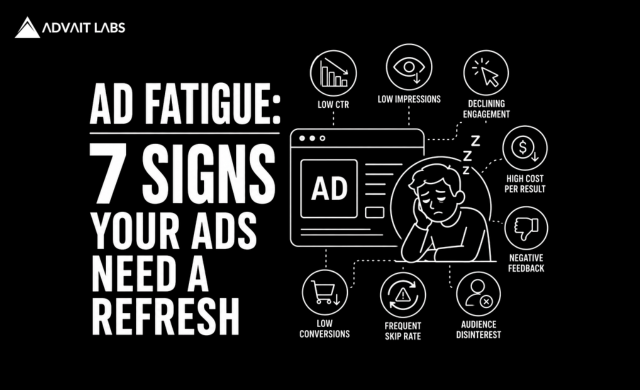
Ad Fatigue can quietly reduce the performance of an otherwise successful advertising campaign. An ad that initially generates strong clicks, engagement, and conversions may gradually lose effectiveness as the same audience sees it repeatedly.
This doesn’t always mean the campaign strategy is wrong. Sometimes, the audience has simply become too familiar with the creative.
For businesses investing in Google Ads, Meta Ads, LinkedIn Ads, or other paid media, identifying Ad Fatigue early can help protect advertising budgets and maintain campaign performance.
At Advait Technology Labs, we help businesses develop and optimize digital advertising campaigns using data-driven strategies. From campaign management and creative testing to audience targeting, conversion tracking, and performance analysis, our approach focuses on improving the effectiveness of paid campaigns.
In this guide, we’ll explain what Ad Fatigue is, the signs to watch for, why it happens, and when your campaign may need a creative refresh.
What Is Ad Fatigue?
Ad Fatigue occurs when an audience sees the same advertisement too frequently and gradually becomes less responsive to it.
As familiarity increases, users may stop noticing the advertisement or become less interested in clicking or engaging with it.
This can result in:
- Lower click-through rates
- Higher cost per click
- Lower conversion rates
- Reduced engagement
- Increased cost per acquisition
- Negative audience feedback
Ad Fatigue is particularly common in campaigns targeting relatively small or highly specific audiences.
Why Does Ad Fatigue Happen?
Advertising performance can decline when users repeatedly encounter similar creative assets.
Common causes include:
Repetitive Ad Creative
Using the same image, headline, video, or message for too long can make an advertisement less noticeable.
Small Audience Size
When a campaign targets a limited audience, the same users may see the advertisement repeatedly.
High Advertising Frequency
A high frequency means users are being exposed to your ads multiple times during a given period.
Long Campaign Duration
Even a strong creative can eventually lose effectiveness if it remains unchanged for too long.
Limited Creative Variation
Running only one or two creative variations gives users fewer messages and visual experiences to interact with.
7 Signs of Ad Fatigue
Recognizing the symptoms early can help advertisers refresh campaigns before performance deteriorates significantly.
1. Click-Through Rate Starts Falling
A declining CTR can indicate that users are becoming less responsive to your ads.
For example, if an advertisement consistently generated strong clicks but engagement begins declining despite similar targeting and budget conditions, creative fatigue could be one possible explanation.
However, CTR should always be evaluated alongside other metrics.
2. Frequency Keeps Increasing
Frequency measures how often users are exposed to your advertising.
A rising frequency isn’t automatically bad. Some campaigns benefit from repeated exposure.
The problem occurs when frequency increases while engagement and conversion performance decline.
This combination can be a strong signal that your audience needs new creative.
3. Cost Per Acquisition Increases
If your cost per acquisition increases while other campaign factors remain relatively stable, the creative may no longer be generating enough response from the target audience.
For example:
Before: ₹500 per conversion
After: ₹850 per conversion
This doesn’t automatically prove Ad Fatigue, but it is a reason to investigate.
4. Engagement Declines
Social advertising campaigns may experience:
- Fewer likes
- Fewer shares
- Lower comments
- Reduced video views
- Lower click activity
A gradual decline across several engagement metrics can indicate that the creative is losing its impact.
5. Negative Feedback Increases
Users may begin hiding ads, reporting them, or leaving negative comments when they feel they are seeing the same advertisement too frequently.
Negative feedback can be an important signal that your campaign needs attention.
6. Conversion Rate Drops
One of the most important warning signs is declining conversion performance.
If traffic remains relatively consistent but fewer users complete the desired action, review:
- Ad creative
- Audience
- Landing page
- Offer
- Conversion tracking
- Campaign settings
Creative fatigue is one possible cause, but it should not be assumed without investigation.
7. Your Best-Performing Creative Starts Losing Momentum
A creative that previously generated strong results may eventually stop outperforming newer or alternative ads.
This is a good opportunity to test new:
- Visuals
- Headlines
- Offers
- Calls to action
- Video openings
- Messaging angles
Ad Fatigue vs. Campaign Performance Problems
Not every performance decline is caused by Ad Fatigue.
A drop in results can also come from:
- Audience changes
- Increased competition
- Budget changes
- Seasonality
- Landing page problems
- Tracking issues
- Changes in customer demand
- Auction dynamics
- Offer changes
Before replacing your creative, examine the campaign as a whole.
How to Fix Ad Fatigue
1. Introduce New Creative
The most obvious solution is to create fresh advertisements.
Consider changing:
- Images
- Videos
- Headlines
- Copy
- Colors
- Layouts
- Calls to action
A creative refresh doesn’t necessarily require completely changing the campaign strategy.
2. Test Different Creative Angles
Instead of simply changing the image, test a different message.
For example, an advertisement could focus on:
Problem:
“Struggling to generate qualified leads?”
Another could focus on:
Benefit:
“Generate more qualified leads with a data-driven marketing strategy.”
Another could focus on:
Proof:
“See how businesses improve campaign efficiency through better targeting.”
Different angles allow you to discover what resonates with your audience.
3. Refresh Video Hooks
For video advertising, the first few seconds are particularly important.
Test different openings such as:
- A direct question
- A common problem
- A surprising statistic
- A customer pain point
- A product demonstration
- A strong benefit
You don’t necessarily need an entirely new video. Sometimes testing a different opening or editing approach can provide useful insights.
4. Expand Creative Variations
Instead of relying on one advertisement, create multiple variations.
For example:
3 headlines × 3 visuals × 2 CTAs
can provide multiple combinations to test.
The exact number of variations should depend on your audience size and campaign budget.
5. Review Audience Targeting
Sometimes what appears to be creative fatigue is actually audience saturation.
Review:
- Audience size
- Geographic targeting
- Demographics
- Interests
- Remarketing audiences
- Exclusions
If the audience is too narrow, expanding it may help reduce repeated exposure.
6. Refresh the Offer
Creative isn’t always the only problem.
If your audience has already seen the same offer repeatedly, consider testing:
- A new promotion
- Additional value
- A different package
- A free resource
- A limited-time incentive
The offer and creative should work together.
How Often Should You Refresh Ad Creative?
There is no universal number of days after which every advertisement should be replaced.
Creative refresh frequency depends on:
- Audience size
- Campaign budget
- Advertising platform
- Campaign objective
- Frequency
- Creative type
- Industry
- Audience behavior
Instead of following a fixed schedule, monitor performance trends and refresh creative when the data suggests that performance is weakening.
How Ad Fatigue Affects Different Advertising Channels
Google Ads
Search ads are influenced heavily by keyword intent, competition, ad relevance, and landing page experience. Responsive Search Ads allow advertisers to test combinations of headlines and descriptions.
Display and video campaigns can experience more obvious creative repetition, especially when audiences are small.
Meta Ads
Ad Fatigue can become noticeable when users repeatedly see the same image, video, or message.
Frequency and declining engagement can provide useful signals.
LinkedIn Ads
B2B campaigns can experience fatigue when targeting highly specific professional audiences.
Creative rotation and different messaging angles can help maintain engagement.
Final Thoughts
Ad Fatigue is a natural challenge that can occur when audiences repeatedly encounter the same advertising creative. Falling CTR, increasing frequency, declining conversions, rising acquisition costs, and reduced engagement can all indicate that it’s time to investigate whether your creative has lost its effectiveness.
The solution isn’t always to completely rebuild the campaign. A strategic creative refresh, combined with audience analysis, offer testing, and performance monitoring, can help maintain campaign effectiveness.
The key is to monitor your data continuously and treat creative testing as an ongoing part of paid advertising rather than a one-time activity.
If your campaigns are generating less engagement or higher acquisition costs, Advait Technology Labs can help analyze your advertising performance and develop a creative and campaign optimization strategy designed around your business goals.
Visit Advait Technology Labs Today!
Frequently Asked Questions
1. What is Ad Fatigue?
Ad Fatigue occurs when an audience becomes less responsive to an advertisement after seeing the same creative repeatedly. It can lead to declining engagement, CTR, conversions, and campaign efficiency.
2. What are the signs of Ad Fatigue?
Common signs include declining CTR, increasing frequency, lower engagement, falling conversion rates, rising cost per acquisition, and increased negative feedback.
3. How can I fix Ad Fatigue?
You can address Ad Fatigue by introducing new creative variations, testing different messaging angles, refreshing video hooks, reviewing audience targeting, and experimenting with new offers.
4. How often should I refresh ad creative?
There is no fixed refresh schedule that works for every campaign. Monitor frequency, engagement, CTR, conversions, and acquisition costs to determine when a creative refresh is necessary.
5. Can Advait Technology Labs help with ad campaign optimization?
Yes. Advait Technology Labs provides Google Ads management, social media advertising, creative strategy, audience targeting, conversion tracking, landing page optimization, and campaign performance analysis.
