

Dayparting in Google Ads: Scheduling for Maximum ROI
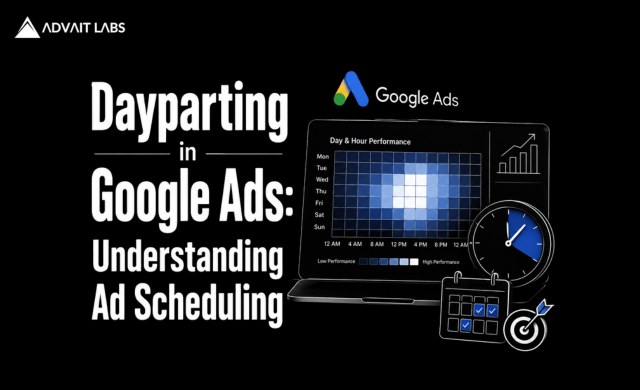
Dayparting in Google Ads is a campaign scheduling strategy that helps businesses control when their ads are shown. Instead of treating every hour and every day equally, advertisers can use performance data to identify when their target audience is most likely to click, enquire, call, or purchase.
Running Google Ads around the clock does not necessarily mean better results. Some businesses receive their highest-quality leads during business hours, while others perform better during evenings, weekends, or specific days of the week. By adjusting campaign schedules based on actual performance, businesses can allocate their advertising budget more strategically.
At Advait Technology Labs, we help businesses optimize Google Ads campaigns using data-driven strategies, including campaign scheduling, audience targeting, keyword optimization, conversion tracking, and performance analysis. In this guide, we’ll explain how Dayparting works, when to use it, and how it can help improve advertising efficiency and ROI.
What Is Dayparting in Google Ads?
Dayparting is the practice of scheduling Google Ads campaigns to run during specific days and times when they are most likely to generate valuable results.
For example, a business could schedule ads to run:
- Monday to Friday
- 9 AM to 6 PM
- Higher priority during 11 AM to 2 PM
- Reduced activity during low-performing hours
The ideal schedule depends entirely on the business, audience, campaign objectives, and historical conversion data.
Dayparting is also commonly referred to as ad scheduling.
Why Does Dayparting Matter in Google Ads?
Not every click has the same value.
Consider a business that receives many clicks late at night but very few enquiries. Meanwhile, traffic between 10 AM and 4 PM may generate fewer clicks but significantly more leads.
If the business focuses only on clicks, it may continue spending heavily during low-converting periods.
Dayparting allows advertisers to evaluate performance based on meaningful business outcomes such as:
- Conversions
- Conversion rate
- Cost per conversion
- Revenue
- Return on ad spend (ROAS)
- Lead quality
This shifts campaign optimization from simply generating traffic to generating valuable results.
How Google Ads Scheduling Works
Google Ads allows advertisers to specify when campaigns should be eligible to show.
Depending on the campaign and setup, advertisers can establish schedules based on:
- Days of the week
- Time ranges
- Business operating hours
- Audience behavior
- Historical performance
Advertisers can then use campaign performance data to determine whether adjustments are necessary.
The goal is not necessarily to advertise for fewer hours. The goal is to allocate budget intelligently based on performance.
Dayparting vs. Running Ads 24/7
A common misconception is that ads should always run continuously to maximize visibility.
However, 24/7 advertising can be inefficient when certain periods consistently produce poor-quality traffic.
For example:
| Time Period | Clicks | Conversions | Cost per Conversion |
| 8 AM–11 AM | 120 | 14 | ₹X |
| 11 AM–2 PM | 160 | 25 | ₹X |
| 2 PM–5 PM | 140 | 20 | ₹X |
| 5 PM–8 PM | 180 | 8 | ₹X |
| 8 PM–11 PM | 150 | 4 | ₹X |
The exact numbers will vary by business, but the principle is important: high traffic does not always mean high business value.
How to Identify the Best Times to Run Google Ads
Before changing your schedule, analyze sufficient historical data.
Look at:
1. Conversion Volume
Which hours and days generate the most conversions?
2. Conversion Rate
Which periods turn the highest percentage of clicks into customers or leads?
3. Cost per Conversion
Are some time periods significantly more expensive?
4. Lead Quality
A low-cost lead is not necessarily a valuable lead.
Check whether leads generated during particular hours actually become customers.
5. Revenue and ROAS
For eCommerce campaigns, evaluate revenue and return on ad spend rather than clicks alone.
Don’t Optimize Dayparting Based Only on Clicks
This is one of the most important considerations.
Suppose:
- Evening = 500 clicks, 5 leads
- Afternoon = 250 clicks, 20 leads
If you optimize only for traffic, you might prioritize evenings.
But if your goal is lead generation, the afternoon clearly deserves closer attention.
Always align scheduling decisions with your conversion goal.
Dayparting for Different Types of Businesses
The ideal schedule differs significantly between industries.
B2B Businesses
B2B companies may see stronger performance during working hours because decision-makers are more active during the business day.
However, this should be confirmed through campaign data.
E-commerce Businesses
Online stores may receive conversions throughout the day.
Evenings and weekends can sometimes perform strongly because consumers have more time to browse and shop.
Local Businesses
Restaurants, clinics, salons, and service providers may benefit from scheduling ads around their operating hours and customer demand.
However, calls and online bookings can occur outside standard business hours, so the data should guide the schedule.
Emergency Services
Businesses offering urgent services may need broader advertising coverage because customer demand can occur at any time.
In such cases, aggressive dayparting could result in missed opportunities.
Dayparting and Budget Management
Dayparting becomes particularly useful when advertising budgets are limited.
Instead of spreading the same budget evenly across the entire day, businesses can concentrate spend around periods that historically produce better results.
This can help:
- Reduce wasted spend
- Improve cost efficiency
- Increase qualified leads
- Improve ROAS
- Make limited budgets work harder
However, advertisers should avoid making schedules too restrictive without enough data.
How to Build a Data-Driven Dayparting Strategy
A practical process looks like this:
Step 1: Define Your Conversion Goal
Decide whether you want:
- Leads
- Calls
- Purchases
- Bookings
- Demo requests
- Revenue
Step 2: Collect Historical Data
Analyze performance by:
- Day
- Hour
- Campaign
- Device
- Location
- Audience
Step 3: Identify Patterns
Look for periods with consistently strong or weak performance.
Step 4: Adjust Your Schedule
Reduce exposure during consistently poor-performing periods and prioritize stronger opportunities.
Step 5: Monitor Results
Compare performance before and after the changes.
Step 6: Continue Testing
Customer behavior changes, so your schedule should evolve with your data.
How Dayparting Works With Other Google Ads Strategies
Dayparting should not be treated as an isolated optimization technique.
It works alongside:
- Keyword optimization
- Negative keywords
- Audience targeting
- Geographic targeting
- Conversion tracking
- Landing page optimization
- Ad copy testing
- Device optimization
- Budget management
Combining these strategies creates a more efficient advertising system.
How Dayparting Supports Better ROI
The ultimate objective of Dayparting is not simply to reduce advertising hours.
It is to improve budget efficiency.
When businesses understand when their audiences are most likely to convert, they can make more informed decisions about where to allocate advertising spend.
The result can be:
Better targeting → Higher-quality traffic → More conversions → Improved ROI
Final Thoughts
Dayparting can help businesses make smarter use of their Google Ads budgets by aligning advertising schedules with customer behavior and conversion performance.
The most effective approach is not to assume that certain hours are automatically better. Instead, analyze historical data, identify meaningful patterns, test scheduling changes, and measure the impact on conversions and revenue.
When combined with strong conversion tracking, keyword targeting, negative keywords, compelling ads, and optimized landing pages, Dayparting can become a valuable part of a broader Google Ads strategy.
If your Google Ads campaigns generate clicks but your advertising ROI isn’t where you want it to be, Advait Technology Labs can help analyze campaign performance and build a data-driven paid advertising strategy focused on improving efficiency and conversions.
Visit Advait Technology Labs Today!
Frequently Asked Questions
What is Dayparting in Google Ads?
Dayparting is the practice of scheduling Google Ads campaigns to run during specific days and times based on audience behavior and campaign performance.
Does Dayparting improve Google Ads ROI?
It can improve ROI when certain time periods consistently generate stronger conversion performance. However, results depend on the business, campaign, audience, budget, and quality of the underlying data.
How do I find the best time to run Google Ads?
Analyze historical performance by day and hour. Focus on conversion rate, cost per conversion, revenue, ROAS, and lead quality rather than clicks alone.
Should Google Ads run 24 hours a day?
Not necessarily. Some businesses benefit from continuous advertising, while others may improve efficiency by adjusting schedules around periods of stronger performance. The correct approach depends on campaign data.
