

Topical Authority: The New SEO Strategy That Replaces Keyword Stuffing
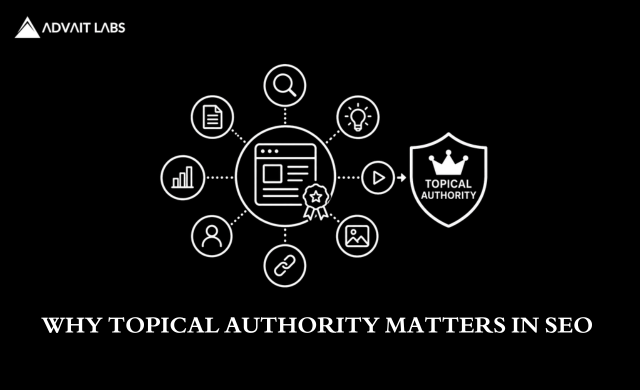
Topical authority is becoming one of the most important SEO ranking factors in modern search. As Google continues shifting toward semantic SEO, AI-powered search, and user-focused ranking systems, businesses can no longer rely on outdated tactics like keyword stuffing to improve visibility. Instead, search engines now prioritize websites that demonstrate deep expertise, strong content structure, and comprehensive topic coverage.
At Advait Technology Labs, we help businesses build long-term SEO growth through topical authority strategies that improve rankings, strengthen organic visibility, and create sustainable search performance in an increasingly AI-driven search environment.
What Is Topical Authority?
Topical authority refers to how strongly a website demonstrates expertise and depth around a specific subject or industry.
Instead of evaluating a single page in isolation, Google now analyzes:
- how comprehensively a website covers a topic,
- how pages connect semantically,
- and whether the content consistently satisfies user intent.
A website with strong topical authority becomes a trusted source within a subject area.
For example:
- a website publishing dozens of high-quality SEO-related articles
- is more likely to rank for SEO topics
- than a general website with only one SEO blog.
This is because Google increasingly rewards:
- expertise,
- consistency,
- and content depth.
Why Keyword Stuffing No Longer Works
Keyword stuffing was once a common SEO tactic where websites repeatedly inserted the same keyword throughout content to manipulate rankings.
This often created:
- poor readability,
- unnatural content,
- and low-value user experiences.
Google’s algorithms have evolved significantly since then.
Modern search systems now understand:
- meaning,
- context,
- relationships between topics,
- and semantic relevance.
As a result, excessive keyword repetition can now:
- reduce content quality,
- hurt user experience,
- and negatively impact rankings.
Today, SEO success depends more on:
- answering user intent,
- building expertise,
- and creating genuinely useful content.
How Google Measures Topical Authority
Google uses multiple signals to evaluate whether a website demonstrates authority.
1. Content Depth
Websites covering topics comprehensively are more likely to rank consistently.
Google evaluates whether content:
- answers related questions,
- covers subtopics,
- and provides meaningful depth.
Thin content rarely performs well in modern SEO.
Businesses must create:
- in-depth guides,
- educational resources,
- and interconnected content ecosystems.
2. Semantic Relevance
Modern SEO relies heavily on semantic understanding.
Google no longer depends only on exact keywords.
Instead, search systems analyze:
- topic relationships,
- contextual meaning,
- user intent,
- and related concepts.
This is why semantic keyword variations matter more than repetitive keyword usage.
3. Internal Linking Structure
Internal linking helps search engines understand:
- topic relationships,
- page hierarchy,
- and content relevance.
Strong topical authority usually includes:
- content clusters,
- pillar pages,
- and strategic internal linking.
This creates a connected knowledge structure across a website.
4. User Engagement Signals
Google also evaluates how users interact with content.
Helpful and authoritative content often generates:
- longer session durations,
- lower bounce rates,
- and stronger engagement.
User satisfaction plays an increasingly important role in SEO performance.
5. E-E-A-T Signals
Google emphasizes:
- Experience,
- Expertise,
- Authoritativeness,
- and Trustworthiness.
Websites demonstrating real expertise and credibility are more likely to build topical authority over time.
Why Topical Authority Matters for SEO
Building authority provides major SEO advantages.
1. Higher Rankings Across Multiple Keywords
Instead of ranking for one keyword, authoritative websites often rank for:
- hundreds of related searches,
- long-tail keywords,
- and semantic variations.
This creates stronger organic visibility overall.
2. Better Visibility in AI Search
AI-powered search systems increasingly favor websites with:
- deep expertise,
- clear structure,
- and comprehensive topic coverage.
As AI search evolves, topical authority becomes even more important.
3. Increased Organic Traffic Stability
Websites relying only on isolated keyword rankings often experience traffic volatility.
Authoritative websites usually maintain:
- stronger ranking consistency,
- broader visibility,
- and long-term organic growth.
4. Improved Trust and Credibility
Users trust websites that consistently publish:
- useful insights,
- expert content,
- and detailed resources.
Topical authority improves both:
- SEO performance,
- and brand credibility.
How to Build Topical Authority
Building topical authority SEO requires strategic content planning and long-term consistency.
1. Create Pillar Content
Pillar content acts as the main resource around a core topic.
For example:
- a complete guide to SEO,
- digital marketing,
- AI search,
- or Google Ads.
Pillar pages should provide:
- comprehensive coverage,
- structured information,
- and strong internal linking opportunities.
2. Build Content Clusters
Content clusters support pillar pages with detailed subtopics.
For example:
A pillar page about SEO may connect to:
- semantic SEO,
- AI Overview SEO,
- local SEO,
- topical authority,
- and search intent optimization.
This strengthens semantic relevance.
3. Focus on Search Intent
Modern SEO depends heavily on satisfying user intent.
Businesses should create content that:
- solves problems,
- answers questions,
- and provides practical value.
Helpful content performs better than content optimized only for keywords.
4. Use Semantic Keywords Naturally
Instead of repeating the same keyword excessively, businesses should use:
- topic-related phrases,
- contextual variations,
- and conversational language.
This improves:
- readability,
- semantic relevance,
- and AI understanding.
5. Publish Consistently
Topical authority develops over time.
Websites that consistently publish:
- high-quality content,
- educational resources,
- and expert insights
are more likely to become trusted sources within their industry.
Topical Authority vs Keyword Stuffing
The difference between these two SEO approaches is significant.
| Keyword Stuffing | Topical Authority |
| Repeats keywords excessively | Focuses on expertise |
| Targets algorithms only | Focuses on users and search intent |
| Creates low-quality content | Creates valuable content |
| Short-term tactic | Long-term strategy |
| Weak semantic relevance | Strong semantic relevance |
| Poor readability | Better user experience |
Modern SEO clearly favors topical authority over outdated optimization methods.
How AI Search Is Increasing the Importance of Topical Authority
AI-powered search systems are transforming how websites are evaluated.
Google increasingly relies on:
- semantic understanding,
- entity relationships,
- and contextual relevance.
This means websites demonstrating:
- comprehensive expertise,
- structured content,
- and topical depth
are more likely to succeed in AI-driven search environments.
The rise of:
- AI Overviews,
- conversational search,
- and semantic SEO
makes topical authority even more important moving forward.
Final Thoughts
Topical authority is becoming one of the most important SEO strategies in 2026.
As Google and AI-powered search systems evolve, websites that demonstrate:
- expertise,
- semantic relevance,
- and comprehensive topic coverage
will consistently outperform websites relying on outdated keyword stuffing tactics.
Businesses that focus on:
- high-quality content,
- strategic content clusters,
- and long-term authority building
will achieve stronger rankings, better visibility, and more sustainable organic growth.
FAQs
1. What is topical authority in SEO?
Topical authority refers to how strongly a website demonstrates expertise and comprehensive coverage around a specific subject.
2. Why is topical authority important?
Topical authority improves rankings,semantic relevance,AI search visibility,and long-term organic traffic growth.
3. Is keyword stuffing bad for SEO?
Yes. Keyword stuffing creates poor user experience and can negatively affect modern SEO performance.
4. How can businesses build topical authority?
Businesses can build topical authority through pillar content,content clusters,semantic SEO,internal linking, and consistent publishing.
5. Does topical authority help AI search rankings?
Yes. AI-powered search systems increasingly favor websites with strong expertise, structure, and semantic relevance.
