

How to Create a 90-Day Digital Marketing Plan for Your Business
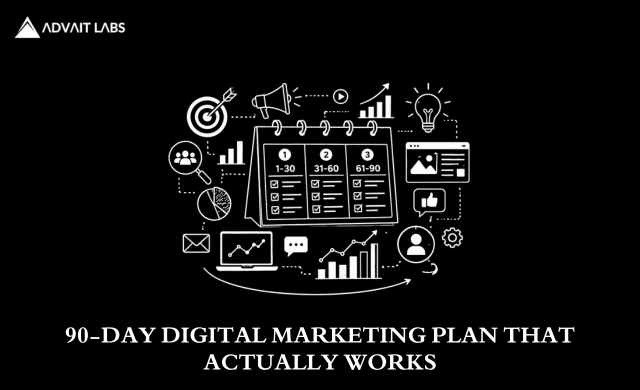
A 90-day digital marketing plan is one of the most practical and effective strategic frameworks available to any business — because it balances ambition with agility. Annual marketing plans look impressive in a boardroom presentation, but they are almost always outdated within weeks of being written. Markets shift, platforms change their algorithms, campaigns underperform, new opportunities emerge — and a rigid twelve-month plan has no mechanism to respond.
A 90-day digital marketing plan + cycle solves this. It is long enough to pursue meaningful goals and see the compounding results of consistent effort. It is short enough to remain accurate, relevant, and responsive to what is actually happening in your market and in your campaigns. Businesses that operate on 90-day digital marketing cycles consistently outperform those that plan annually and review quarterly — because they are making course corrections four times a year instead of once.
At Advait Labs, digital strategy is one of our core services. We build 90-day marketing plan for businesses across Hyderabad — covering digital strategy, search engine marketing, social media marketing, content marketing, website optimization, and online media buying — that are grounded in real data, aligned with business goals, and designed to deliver measurable results within the planning period.
Want a custom 90-day digital marketing plan built for your Hyderabad business? Advait Labs provides expert digital strategy and marketing planning — tailored to your goals.
Call: +91 8179208586 | www.advaitlabs.com
Phase 1: The Foundation (Days 1–30) — Audit, Align, and Prioritise
Step 1: Conduct a Full Digital Marketing Audit
Before building a plan, you need an accurate picture of where you are. A digital marketing audit covers your current performance across every active channel:
• Website: traffic sources, bounce rate, page speed, Core Web Vitals, conversion rate, and top-performing pages
• SEO: keyword rankings, organic traffic trends, backlink profile, technical errors, and content gaps
• Paid advertising (SEM): campaign performance, cost per lead, quality scores, and wasted spend
• Social media marketing: follower growth, engagement rates, top-performing content, and paid campaign results
• Content marketing: blog traffic, top-performing posts, content gaps, and search visibility
• Online media buying: reach, frequency, viewability, and attribution of display and programmatic campaigns
The audit reveals what is working, what is wasting budget, and where the highest-return opportunities lie. It becomes the factual foundation on which every priority in your 90-day plan is built.
Step 2: Set Specific, Measurable Goals
Vague goals produce vague results. ‘Get more leads’ is not a goal — it is a wish. ‘Generate 50 qualified leads per month through Google Search Ads at a cost per lead below ₹800 by the end of month 3’ is a goal. Every objective in your 90-day plan should follow the SMART framework: Specific, Measurable, Achievable, Relevant, and Time-bound.
Set no more than three to five primary goals for the 90-day period. More than this spreads effort too thin and makes it difficult to attribute results. Choose the goals that are most directly connected to business growth — leads, revenue, qualified enquiries, or bookings — and build your channel strategy around them.
Step 3: Define Your Priority Channels
Not every digital channel deserves equal attention in every 90-day cycle. Based on your audit findings and your goals, identify the two to three channels that offer the highest return on effort for this specific planning period. For a business with no search presence, SEO and SEM should be the priority. For a business with strong organic traffic but low conversion rates, website optimisation and CRO deserve focus. For a new brand launch, social media marketing and online media buying build awareness fastest.
Phase 2: Execution (Days 31–75) — Build, Launch, and Iterate
Week-by-Week Execution Framework
The execution phase is where most plans fail — not because the strategy is wrong, but because the weekly actions are not specific enough. For each priority channel, define the exact deliverables expected each week:
• SEO and content marketing: two blog posts per week, one technical fix per week, one backlink outreach campaign per month
• Search engine marketing: campaign launch in week 1, A/B test of ad copy in week 3, landing page optimisation in week 5
• Social media marketing: four posts per week, one paid campaign per month, community engagement daily
• Website design updates: one CRO test launched every two weeks based on heatmap and analytics data
Weekly execution cadence creates momentum and ensures that the plan is being actively worked, not sitting as a document that is consulted once a month.
Campaign Launch Sequencing
Not all channels should launch simultaneously. A logical sequencing — typically website and tracking first, then paid search, then organic content, then social — ensures that each channel has the infrastructure it needs to perform and that early campaign data informs later decisions. Launching all channels at once without proper tracking in place means flying blind on performance attribution from day one.
Weekly Performance Reviews
Set aside 60–90 minutes every week to review the previous week’s performance data across all active channels. Key questions for each review:
• Are we on track to hit our 90-day goals? If not, why not and what needs to change?
• Which specific campaigns, posts, or content pieces performed best, and can we replicate or scale them?
• Where is the budget being spent with poor return, and should it be reallocated?
• Are there any new opportunities — trending topics, competitor gaps, seasonal moments — we should act on this week?
Phase 3: Optimisation and Planning (Days 76–90) — Measure, Learn, Plan Ahead
Comprehensive Performance Analysis
The final two weeks of the 90-day cycle are for analysis and forward planning. Measure every goal you set in Phase 1 and calculate your actual performance against target. Go beyond the headline numbers — understand which specific activities drove the best results, which channels over- or underperformed relative to expectations, and what the data says about where your customers are coming from and what is converting them.
Build Your Next 90-Day Plan
The last action of every 90-day cycle is drafting the next one. Armed with three months of real performance data, your next plan will be more accurate, better prioritised, and built on a foundation of proven strategies rather than assumptions. This compounding cycle — plan, execute, measure, plan again — is what separates businesses that grow predictably from those that lurch from one campaign to the next without a coherent strategy.
Conclusion
A 90-day digital marketing plan gives your business the structure to pursue ambitious growth goals while remaining agile enough to respond to what the data reveals. It prevents the common failure mode of annual plans that are immediately outdated, and it creates a compounding improvement cycle that makes each quarter more effective than the last.
The businesses in Hyderabad that grow consistently and predictably are almost always the ones that plan deliberately, execute consistently, measure honestly, and adjust based on evidence. A well-built 90-day digital marketing plan is the operational tool that makes that discipline possible.
📍 Visit Us in Hyderabad Advait Labs
Frequently Asked Questions
Q: Why 90 days instead of 6 months or 12 months?
A: 90 days is long enough to see meaningful results from SEO and content marketing, and short enough to stay accurate in a fast-changing digital environment. Annual plans are almost always outdated within months of being written.
Q: What should be the first priority in a 90-day digital marketing plan?
A: Start with an audit of your current performance. Without knowing where you are, you cannot prioritise intelligently. The audit reveals which channels are underperforming and where the highest-return opportunities lie.
Q: How many goals should a 90-day plan include?
A: Three to five primary goals maximum. More than this spreads focus too thin and makes performance attribution difficult. Each goal should be specific and measurable — a number, a date, and a channel.
Q: Can small businesses benefit from a 90-day digital marketing plan?
A: Absolutely — in fact, structured 90-day planning is more important for small businesses than large ones, because small businesses cannot afford to waste budget on activities that are not delivering results. A clear plan ensures every rupee is working toward a defined goal.
Q: How does Advait Labs help with digital strategy?
A: Digital strategy is one of Advait Labs’ confirmed core services. We audit your current digital performance, set measurable goals, prioritise channels based on your business objectives, and build an actionable plan covering SEM, social media, content marketing, website optimisation, and online media buying.
